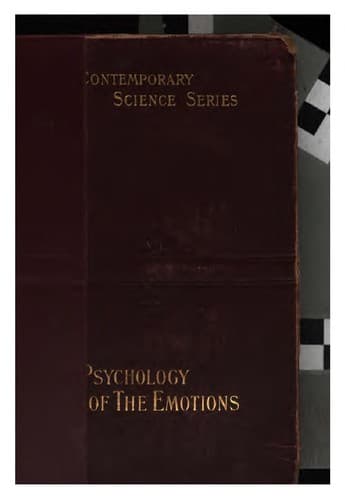
The Psychology of the EmotionsRibot, Th. (Théodule)
Science
The Psychology of the Emotions
Ribot, Th. (Théodule)
Emotions
About 1820, during the time of scarcity consequent on Tshaka’s
wars, certain of the Natal tribes (the natives say, at the
suggestion of a chief named Umdava) adopted the practice of
cannibalism. It was abandoned when food again became plentiful,
and has always been regarded with great horror; those individuals
who had acquired such a taste for human flesh as to prefer it to
other food, fled into the recesses of the Drakensberg and Maluti
mountains. Moshesh, the great Basuto chief, directed his efforts
for years to the extirpation of the practice, though unwilling to
do so, as his advisers desired, by means of a summary massacre of
the offenders. The _Amazimu_ (_Modimo_) are now a myth to both
Zulus and Basutos; indeed the word, as now used, is frequently
synonymous with “ogre.” It is to be noted that Moshesh was not in
any way acting under European influence, in fact the last of the
cannibals had disappeared long before the country came under
British rule, and though the memory of their atrocities was still
fresh when the French missionaries arrived in 1833, the chief had
already been proceeding against them for some time. See Casalis,
_Les Bassoutos_.
-----
-----
Footnote 181:
Staniland Wake, _Evolution of Morality_, vol. i. pp. 427 _et seq._
To be consulted for facts of this kind.
-----
It would be easy to continue this historical demonstration, but the
above is sufficient to justify the term discoverers. From causes of
which we are ignorant, but analogous to those which produce great
poets or painters, there arise men of indisputable moral superiority
who _feel_ what others do not feel, just as a great poet does
compared with ordinary men. And for one who has succeeded, how many
have failed for want of a favourable environment! A St. Vincent de
Paul among the Kanakas would be as impossible as a Mozart among the
Fuegians.
In primitive societies there has been a long struggle between the
strongest egoistic tendencies, with their dissolvent action, and the
weaker and intermittent altruistic tendencies, which have progressed
through the agency of some more enlightened individuals, and also
with the help of force, of which we still have to speak.
II. Let us now examine the development of the moral sentiment under
its negative and restrictive aspect—_i.e._, as the sense of justice.
Here the intellectual element evidently preponderates, and its
evolution involves the other.
“Justice,” says Littré, “has the same foundation as science.” One
rests on the principle of identity which governs the region of
speculation, the other rests on the principle of equivalence and
rules the sphere of action. Justice, in its origin, is a
compensation for damages. Its evolution starts from an instinctive
semi-conscious manifestation, rising by progressive steps to a
universalist conception. Let us mark the principal stages.
Public-domain text, read in full here on John Shaqi.
Reviews
Reviews
No reviews yet
Be the first to share your thoughts on this work.
Elsewhere in the archive
Join the Discussion
Join the discussion
Sign in to leave a comment or review.
Sign InorCreate an account