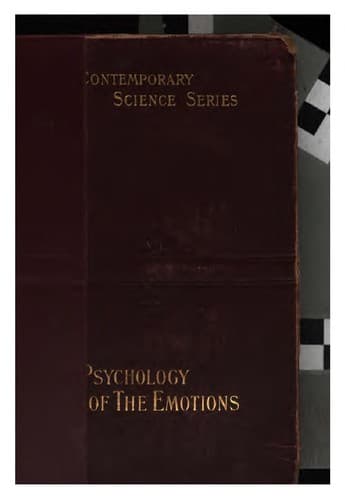
The Psychology of the EmotionsRibot, Th. (Théodule)
Science
The Psychology of the Emotions
Ribot, Th. (Théodule)
Emotions
It only remains that it should become universal. It long remains
enclosed within the limits of the social group. All that contributes
to the material and moral welfare of the group is good, and
conversely; outside the group, all acts are _unmoral_. We find in
history, and even at the present time, many proofs of this dualism
or duplication of the individual, according as he is acting within
his own social environment or with regard to strangers. Such were
the Germans of Cæsar’s time.[183] In their earlier period, the
Greeks considered themselves as less under moral obligation towards
the Barbarians, and the Romans towards foreigners (_hostes_). It is
especially owing to the efforts of the philosophers—Socrates, Plato,
Aristotle, the Stoics—that justice ceased to be national and became
universal. It might be added that at that period when the notion of
justice remains a national one, it still varies within the group,
according to caste; it is not the same for priests and warriors, for
free men and for slaves, for aristocrats and for merchants. In the
beginning, particularism was the rule.
-----
Footnote 183:
“Latrocinia nullam habent infamiam quæ extra fines cujusque
_civitatis_ fiunt.”—_De Bell. Gall._, vi. 21.
-----
It is evident that, on the negative side, the evolution of moral
life has been especially due to the progress of intelligence; the
emotional element has only been incidental. Compared with the sense
of justice, the feeling of active benevolence, if not evolved more
quickly, at least appeared sooner, because nearer to instinct and
less dependent on reason. A certain philosopher (Kant, I believe)
was surprised that there is so much kindness and so little justice
among men. He did not observe as a psychologist, or else he was led
astray by intellectualist prejudice. This must be so, because
tenderness is innate and spontaneous, justice acquired and
deliberate; because one springs directly from an instinct, while the
other has to undergo various metamorphoses. If man is sociable and
moral, it is less because he thinks than because he feels in a
certain manner and tends in a certain direction.
Public-domain text, read in full here on John Shaqi.
Reviews
Reviews
No reviews yet
Be the first to share your thoughts on this work.
Elsewhere in the archive
Join the Discussion
Join the discussion
Sign in to leave a comment or review.
Sign InorCreate an account