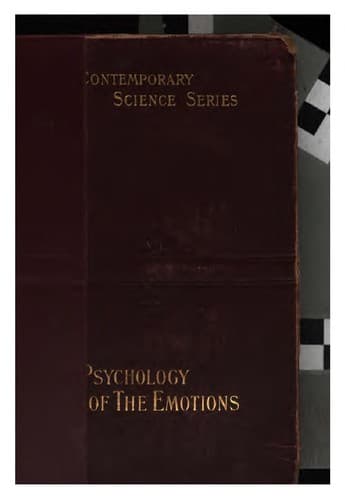
The Psychology of the EmotionsRibot, Th. (Théodule)
Science
The Psychology of the Emotions
Ribot, Th. (Théodule)
Emotions
_Dictionary of Psychological Medicine_, art. “Criminal
Anthropology.” Here it is stated that, at Elmira, 34 per cent.
criminals on admission exhibit entire absence of moral
susceptibility; while (according to Dr. Salsotto, at Turin) in 130
women guilty of murder, or complicity in murder, genuine remorse
was only observed in 6.
-----
Moral insensibility is usually innate, and coincident with other
symptoms of degeneracy. Among several children of the same family,
brought up in the same surroundings, having received the same care,
a single one may differ from all the rest, be amenable neither to
gentleness nor to force, and manifest a precocious depravity, which
will only strengthen as he grows older.
This state may be acquired and momentary, its causes being epilepsy,
hysteria, apoplexy, paralytic dementia, senile decay, blows on the
head, etc. Krafft-Ebing, besides an observation made by himself
(_loc. cit._), quotes from Wigan the case of a young man who, in
consequence of being struck on the head with a ruler, developed
complete moral insensibility. When, by means of the operation of
trephining, a splinter of bone pressing on the brain had been
removed, he returned to his former state. We have met with other
analogous cases in the course of this work.
The most difficult and fiercely debated point is whether this moral
anomaly is strictly instinctive and emotional in its origin,
intellectual activity being entirely unconnected with it. Most
writers take the affirmative view of this question, others deny it.
The different modes of mental activity are so interdependent, and
their relations so close, that it is difficult to solve the question
definitely. We cannot refuse to admit that the intellect sometimes
suffers from a counter-shock; but observation shows that most of
these persons are well acquainted with the requirements of morality,
and have had the abstract ideas of good, of evil, and of duty
instilled into them by education, though without the slightest
influence on their conduct. They have moral _ideas_, not moral
feelings—_i.e._, a disposition to feel and act. The law is to them
nothing but a police regulation, which they are conscious of having
broken. Their intellect, often firm and clear, is only an instrument
for weaving skilful plots, or justifying themselves by subtle
sophisms.
It was worth our while to recall, if only in a cursory manner, the
nature of moral insensibility, in order to show the importance of
the emotional element. In these cases there is a lack of
completeness, and the deficit comes, not from the intellect, but
from the character.
CHAPTER IX.
THE RELIGIOUS SENTIMENT.
Public-domain text, read in full here on John Shaqi.
Reviews
Reviews
No reviews yet
Be the first to share your thoughts on this work.
Elsewhere in the archive
Join the Discussion
Join the discussion
Sign in to leave a comment or review.
Sign InorCreate an account