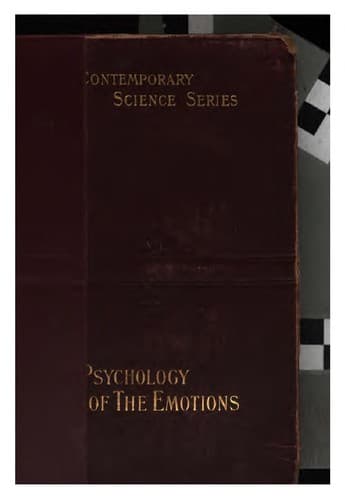
The Psychology of the EmotionsRibot, Th. (Théodule)
Science
The Psychology of the Emotions
Ribot, Th. (Théodule)
Emotions
The second theory, that of Herbert Spencer, brings us down from the
notion of the Infinite to the extremely terrestrial mental life of
savages. It is well known that he reduces all primitive religions to
the cult of ancestors—to necrolatry. The primordial fact is the
conception of a spirit, or rather, of a _double_. The savage
believes that he has a Sosia, or, in other words, a principal _ego_
and a secondary _ego_. He infers the existence of this double from a
great number of facts, to him inexplicable: his shadow, his
reflection in the water, echoes, apparitions in dreams, fainting,
trances, epilepsy, etc. The world is thus, for him, full of
wandering spirits which he tries to propitiate. According to
Spencer, fetichism and polytheism are only aberrant forms of
ancestor-worship, and he tries to prove this by a series of
arguments, through which we need not now follow him. Imperturbable
in his systematic deduction, he even asserts that he can derive from
the same root, by far-fetched and easily-controverted arguments, the
adoration of animals, plants, and inanimate objects.[192] It is
indisputable that a great number of beliefs have sprung from this
root, but this conception, which is anthropomorphism carried to its
extreme, is found to be too narrow to include all the facts. Tylor
and others have criticised it with some vivacity, and I do not think
that it now claims many adherents.
-----
Footnote 192:
_Principles of Sociology_, vol. i. pp. 130-142.
-----
These two systematic hypotheses being put on one side, we may remind
the reader how religious development _seems_ to have taken place
during this primitive period; for the march of evolution has not
been everywhere and always the same—a difficulty already pointed out
with regard to the social instinct. According to the best
authorities, the most frequent form has been the following.
The first stage is that of fetichism, polydemonism, naturism—terms
which in the history of religions are not quite synonymous, but
which answer to the same psychical condition, the adoration of some
object, living or not, which is _perceived_—_i.e._, apprehended as a
concrete form, at the same time body and soul—or rather animated by
a soul, judged to be benevolent or malevolent, useful or injurious;
for there is scant justification for the opinion that the worshipper
of a piece of wood or stone sees in it only a purely material
object.
The second stage is that of animism or spiritism, “a belief in
spirits having no substantial bond or necessary connection with
determinate natural objects.” The spirit is conceived as
independent, separable; it goes and comes, enters and departs; it is
attributed not only to men, but also to animals: the savage tries to
deprecate the wrath of the beast he has killed in hunting, the chief
has his horses and dogs buried with him. Psychologically, this stage
corresponds to a preponderance of the imagination over simple
perception.
Public-domain text, read in full here on John Shaqi.
Reviews
Reviews
No reviews yet
Be the first to share your thoughts on this work.
Elsewhere in the archive
Join the Discussion
Join the discussion
Sign in to leave a comment or review.
Sign InorCreate an account