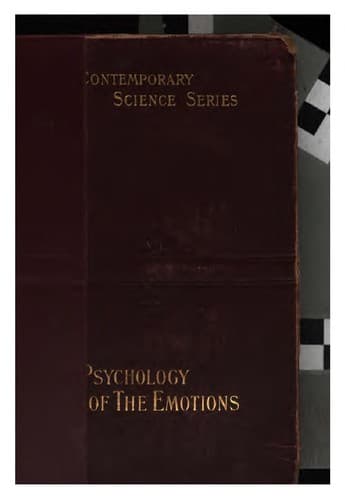
The Psychology of the EmotionsRibot, Th. (Théodule)
Science
The Psychology of the Emotions
Ribot, Th. (Théodule)
Emotions
II. The morbid exaltation of the religious feeling is derived from
attraction and love, as depression springs from fear. Related to
joy, and sometimes to megalomania, it is accompanied by partial or
total augmentation of both the physical and psychical life.
Ecstasy is a transitory and comparatively passive form. Seen from
without, it resembles catalepsy in the insensibility to external
impressions, and suspension of sensory activity. It differs from it
on the motor side. The ecstatic has not the “flexibility of wax” and
the complete immobility; he can move, walk, speak, and his face can
assume any given expression. Seen from within, ecstasy is an intense
state of consciousness, of which the recollection remains after
awaking, while catalepsy is attended by unconsciousness, or, at
least, complete oblivion. Its psychology is simple enough, if,
neglecting details, we confine ourselves to the essential
conditions. The confessions of ecstatics, which are tolerably
numerous, agree in their principal features: (1) restriction of the
area of consciousness, with one intense and overmastering
representation serving as the pivot and only centre of association;
(2) an emotional state—rapture—a form of love in its highest degree,
with desire and the pleasure of possession, which, like profane
love, only finds its end in complete fusion and unification (ἐνῶσις
of the Alexandrians). The declarations of the great mystics, however
involved they may be in metaphor, leave us in no doubt on this
point;[202] and their critics, even theologians, have reproached
them with frequently being mistaken in the nature of their love.
-----
Footnote 202:
For further details respecting ecstasy I refer the reader to my
_Maladies de la volonté_, ch. v., and to Godfernaux, _Le Sentiment
et la Pensée_, p. 49. Purely medical works contain little that is
instructive with regard to the psychology of this state; the works
of the mystics themselves may be studied with far more profit.
-----
Public-domain text, read in full here on John Shaqi.
Reviews
Reviews
No reviews yet
Be the first to share your thoughts on this work.
Elsewhere in the archive
Join the Discussion
Join the discussion
Sign in to leave a comment or review.
Sign InorCreate an account