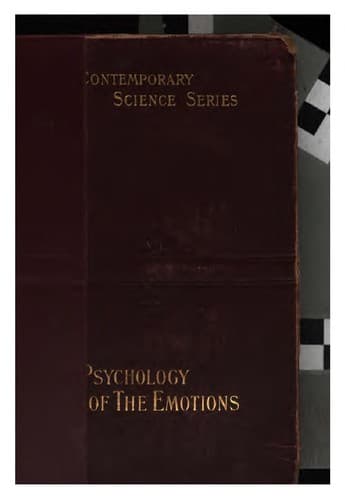
The Psychology of the EmotionsRibot, Th. (Théodule)
Science
The Psychology of the Emotions
Ribot, Th. (Théodule)
Emotions
I.
On the origin of æsthetic feeling, and consequently on the character
peculiar to it among all other emotions, writers belonging to all
schools of philosophy are in agreement to an extent rarely found
elsewhere. It has its source in a superfluity of life—a luxury of
activity; in fact it is a form of play. Schiller is supposed to have
been the first to state its formula: “Supreme art is that in which
play reaches its highest point, when we play, so to speak, from the
depths of our being. Such is poetry, and especially dramatic
poetry.... As the gods of Olympus, free from all wants, knowing
nothing of work or of duty, which are limitations of being, occupied
themselves in taking mortal forms in order to play at human
passions, so, in the drama, we play with the achievements, crimes,
virtues, vices, which are not our own.”[203] Kant referred the
beautiful to the free play of the intellect and the imagination, and
his immediate disciples follow him on this point. Schopenhauer says
the same thing in other words, “Art is a momentary liberation.”
Finally, Herbert Spencer develops this thesis, from the experimental
point of view, by connecting it with biological conditions.
-----
Footnote 203:
This theory of play, however, appears, from recent researches, to
be of English origin, and due to Home (1696-1782), so that, when
taken up again by Herbert Spencer (_Principles of Psychology_,
vol. ii., last chapter), it would seem only to have returned to
its original home.
-----
The primary activity of our physical and mental faculties relates to
proximate ends: the conservation of the individual, and his
adaptation to his environment. The secondary activity is its own
end, and is of somewhat late appearance in the animal kingdom. The
lower animals are shut up in a narrow circle: they feed, defend
themselves, sleep, and propagate their species. On a higher level
appears “a useless activity of unused organs” (Spencer, _op. cit._,
ii. p. 630); as in the rat with incisors growing continuously in
adaptation to the excessive wear they undergo; the cat, exercising
her claws on the bark of a tree or the covering of a chair, etc.
Higher still appears the true play-impulse; dogs pretending to hunt
or fight, cats running after a ball which they catch, push away,
catch again, and pursue, bounding as if after their prey. In
children, we know the pre-eminent function of play, and how it
differs according to sex, disposition, and age: it has its
individual characteristics, and is often a creation.
Public-domain text, read in full here on John Shaqi.
Reviews
Reviews
No reviews yet
Be the first to share your thoughts on this work.
Elsewhere in the archive
Join the Discussion
Join the discussion
Sign in to leave a comment or review.
Sign InorCreate an account