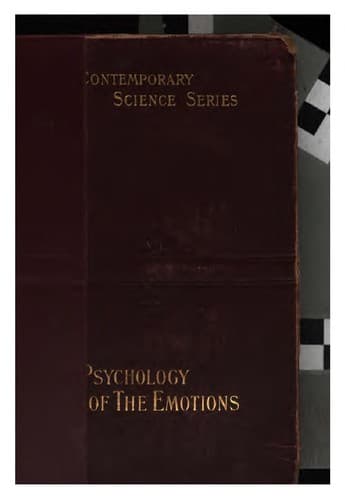
The Psychology of the EmotionsRibot, Th. (Théodule)
Science
The Psychology of the Emotions
Ribot, Th. (Théodule)
Emotions
this explanation is the true one I feel by no means clear. I throw
it out simply as a suggestion, confessing that this peculiar emotion
is one which neither analysis nor synthesis enables me clearly to
understand."
Footnote 45:
_Principles of Psychology_, ii., § 518.
This explanation seems to me only a partial one, and not applicable
to all cases. In my opinion, no efforts of this kind can be
successful, because the authors remain on the ground of normal
psychology. This class of facts ought to be treated by the
pathological method. It may be said that this is only the
substitution of one word for another. By no means, as we shall see
by the result.
The mistake lies in attacking, in the first instance, phenomena of
too delicate a nature, and considering them as isolated facts. We
must proceed, not by synthesis or analysis, but by the cumulative
method—_i.e._, we must establish a chain of facts, of which the last
links, being of overwhelming importance, shall throw light on the
first. I indicate the principal stages of this gradation
thus—Æsthetic melancholy (transitory and intermittent); spleen,
melancholia (in the medical sense);[46] then, advancing a step
further, suicidal tendencies, and finally, suicide. This last term
makes all the others comprehensible. The first stages are only
embryonic, abortive, or modified forms of the tendency to
self-destruction, of the desire which makes it seem agreeable. The
weaker forms—checked in an immense majority of cases—approximate
more or less to destruction, and can only be explained if compared
with the extreme case.
Footnote 46:
Krafft-Ebing remarks: “An abnormal mode of feeling on the part of
melancholic patients is found in the enjoyment of pain
(_Leidseligkeit_). In these individuals, ideas which, in a healthy
slate, would be provocative of pain, awaken in the diseased
consciousness a faint feeling of satisfaction which represents the
corresponding affective tone.”
The evolutionists have stated the hypothesis that there must have
existed certain animals so constituted that, in them, pleasure was
connected with destructive acts, pain with useful ones, and that, as
every animal seeks pleasure and shuns pain, they must have perished
in virtue of their very constitution, since they sought the
destructive and shunned the preservative influences. There is
nothing chimerical in this supposition, for we see men find pleasure
in acts which, as they very well know, will speedily result in their
deaths. A being thus constituted is abnormal, illogical; he contains
within himself a contradiction of which he will perish.
Public-domain text, read in full here on John Shaqi.
Reviews
Reviews
No reviews yet
Be the first to share your thoughts on this work.
Elsewhere in the archive
Join the Discussion
Join the discussion
Sign in to leave a comment or review.
Sign InorCreate an account