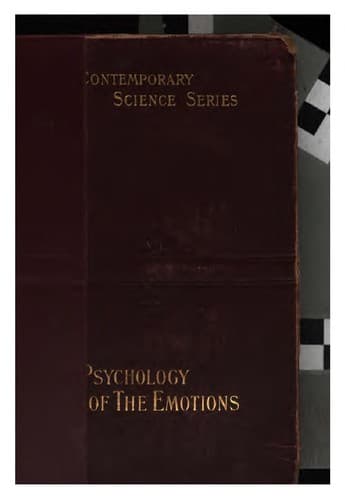
The Psychology of the EmotionsRibot, Th. (Théodule)
Science
The Psychology of the Emotions
Ribot, Th. (Théodule)
Emotions
"The reflexes of pains which, in later life, show themselves in
the acutest manner, are those best developed in early life.
Gunzmer’s observations on about sixty infants showed him that,
during the first few days, they are almost insensible, and during
the first week, very slightly sensitive, to the pricking of a
needle.
“New-born infants have been, in the course of their first day,
pricked with fine needles, on the nose, the upper lip, and the
hand, deeply enough to draw a drop of blood; yet the child
manifested no symptom of consciousness, and did not start
once.”—Preyer, _Seele des Kindes_, pp. 177, 193.
Leaving aside this question of origin, it is impossible to close the
study of pleasure and pain without a summary recapitulation of the
general theories forming the philosophy of our subject. These may be
classified under two heads: the _how_ and the _why_; what are the
conditions of existence of pleasure and pain? and what is their
utility?
I.
On the first point there has been, from antiquity to the present
day, an almost universal and very rare agreement between different
schools: pleasure has, as its condition, an increased, pain a
diminished activity. I employ this vague formula designedly, because
it covers all special formulas. Of these it would be idle to
enumerate even the chief. At bottom, in language varying according
to the era and the doctrine, all authors say the same thing,
employing, according to their cast of intellect, a metaphysical,
physical (Léon Dumont), physiological, or psychological formula. The
intellectualists themselves agree with the others; considering
sensibility as a confused form of intelligence, they say that
pleasure is a confused judgment of perfection, and pain a confused
judgment of imperfection. In short, if each formula is stripped of
the variations adapting it to the particular philosophy of each
author, there is a common residue, which, in all alike, is the
essential.
The history of these variations on the same theme would be
monotonous and unprofitable; it is as well, however, to note that,
as our own century advances, the theoretic conception of the
ancients tends to grow more precise, to rely more on the support of
experience and be justified thereby. We have already seen the two
formulas—augmentation, diminution—taking definite shape, showing
themselves in the objective and observable changes of nutrition, of
the secretions, the movements, the circulation, and the breathing.
Public-domain text, read in full here on John Shaqi.
Reviews
Reviews
No reviews yet
Be the first to share your thoughts on this work.
Elsewhere in the archive
Join the Discussion
Join the discussion
Sign in to leave a comment or review.
Sign InorCreate an account