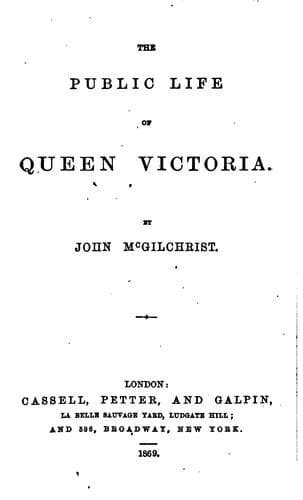
The Public Life of Queen VictoriaMcGilchrist, John
History
The Public Life of Queen Victoria
McGilchrist, John
Victoria, Queen of Great Britain, 1819-1901
We have already remarked the wide range of Prince Albert's endeavours,
study, devotion, and consequent usefulness. He presided at dinners of the
Literary Fund, and of the Royal Academy; at the Trinity House most
frequently, and at many agricultural meetings. Two of the best and most
pregnant with good of his addresses, were delivered at the meetings of
associations designed respectively for the better housing of labourers,
and in behalf of the large and sorely tempted class of domestic servants.
Now he presided at the Bicentenary of the Corporation of the Sons of the
Clergy; again at the two hundredth anniversary of one of our most
illustrious regiments of Foot Guards. On art, as all were prepared to
expect, he delivered ripe words of wisdom at the Royal Academy in
Trafalgar Square, and in laying the foundation in the capital of his
wife's Stuart ancestors of a new National Gallery for her Scottish
subjects. Against the expectation, and to the loudly expressed surprise of
all, save those who knew him thoroughly, he made a most admirable survey
of the sciences and their uses, at one of the last meetings held ere his
death, of the British Association for the Advancement of Science. Of art
he was a judicious critic, as well as a munificent patron. It was at his
special wish and option that the _savant_ Lyon Playfair was made one of
his Equerries; and that a residence in Hampton Court Palace was put at the
disposal of Michael Faraday.
How much of mingled love for art and artists, and at the same time of
criticism most kindly and sagacious, is to be found in these brief
sentences, extracted from his great speech at the Royal Academy dinner:--
An unkind word of criticism passes like a cold blast over their tender
shoots, and shrivels them up, checking the flow of the sap, which was
rising to produce, perhaps, multitudes of flowers and fruits. But
still criticism is absolutely necessary to the development of art,
and the injudicious praise of an inferior work becomes an insult to
superior genius. In this respect, our times are peculiarly favourable
when compared with those when Madonnas were painted in the seclusion
of convents; for we have now on the one hand the eager competition of
a vast array of artists of every degree of talent and skill, and on
the other, as judge, a great public, for the greater part wholly
uneducated in art, and thus led by professional writers who often
strive to impress the public with a great idea of their own artistic
knowledge, by the merciless manner in which they treat works which
cost those who produced them the highest efforts of mind or feeling.
Public-domain text, read in full here on John Shaqi.
Reviews
Reviews
No reviews yet
Be the first to share your thoughts on this work.
Elsewhere in the archive
Join the Discussion
Join the discussion
Sign in to leave a comment or review.
Sign InorCreate an account