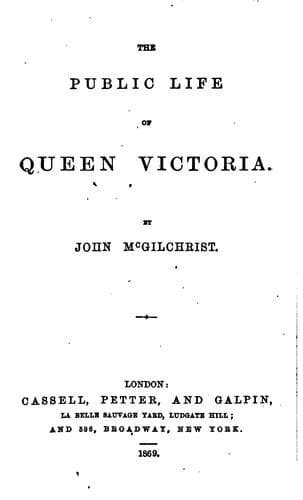
The Public Life of Queen VictoriaMcGilchrist, John
History
The Public Life of Queen Victoria
McGilchrist, John
Victoria, Queen of Great Britain, 1819-1901
_Saturday, 23rd._--I went down to Walmer Castle, and found the Duke
walking with Mr. Arbuthnot on the ramparts, or, as it is called, the
platform, which overlooks the sea.... After the company had departed
at ten o'clock, I sat up with the Duke and Arbuthnot till twelve
o'clock, talking on various topics.... I see that the Government was
evidently opposed to the Queen's visit to Eu. It was a wily intrigue,
managed by Louis Philippe, through the intervention of his daughter,
the Queen of the Belgians, during her frequent visits to Windsor with
King Leopold, and was hailed by him with extreme joy, as the first
admission of the King of the Barricades within the pale of legitimate
sovereigns. The Duke said, "I was never let into the secret, nor did I
believe the report then in circulation, till at last they sent to
consult my opinion as to forming a regency during the Queen's absence.
I immediately referred to precedents as the only proper guide. I told
them that George I., George II. (George III. never went abroad), and
George IV. had all been obliged to appoint councils of regency; that
Henry VIII., when he met Francis I. at Ardres, was then master of
Calais, as also when he met Charles V. at Gravelines; so that, in
these instances, Calais being a part of his dominions, he hardly did
more than pass his frontier--not much more than going from one county
to the next. Upon this I decided that the Queen could not quit this
country without an Act of Regency. But she consulted the crown
lawyers, who decided that it was not necessary, as courtiers would
do." I myself (resumes Raikes) did not believe in her going till two
days before she went. Peel persisted afterwards that he had told me of
it; but I knew I never heard it, and it was not a thing to have
escaped me if I had.
As for the reception at the Chateau d'Eu itself, it was of the most
splendid character. One state ceremonial, however, is so very like
another, that after those, the descriptions of which we have already
furnished, a recital of the gay doings at Eu would hardly be palatable.
The purport of the whole may be summed up very briefly. The French monarch
endeavoured to allure the Queen into compliance with his wishes, by every
seduction which nature and art, and the most refined and gallant courtesy,
could supply. Everything that wealth, luxury, and taste could furnish was
to be found amid scenes of more than royal magnificence, o'ershadowed by
elms that dated back to the times of Henri Quatre.
Public-domain text, read in full here on John Shaqi.
Reviews
Reviews
No reviews yet
Be the first to share your thoughts on this work.
Elsewhere in the archive
Join the Discussion
Join the discussion
Sign in to leave a comment or review.
Sign InorCreate an account