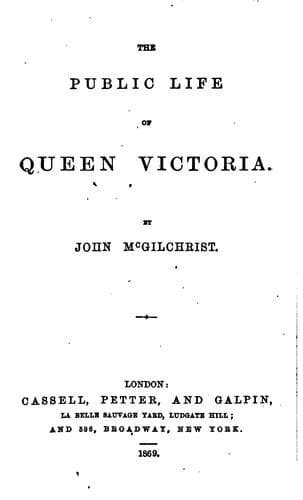
The Public Life of Queen VictoriaMcGilchrist, John
History
The Public Life of Queen Victoria
McGilchrist, John
Victoria, Queen of Great Britain, 1819-1901
The Queen requires, first, that Lord Palmerston will distinctly state
what he proposes in a given case, in order that the Queen may know as
distinctly to what she is giving her Royal sanction. Secondly, having
once given her sanction to a measure, that it be not arbitrarily
altered or modified by the Minister. Such an act she must consider as
failing in sincerity towards the Crown, and justly to be visited by
the exercise of her constitutional right of dismissing that Minister.
She expects to be kept informed of what passes between him and the
Foreign Ministers, before important decisions are taken based upon
that intercourse; to receive the foreign despatches in good time, and
to have the drafts for her approval sent to her in sufficient time to
make herself acquainted with their contents before they must be sent
off. The Queen thinks it best that Lord John Russell should show this
letter to Lord Palmerston.
[Sidenote: DISMISSAL OF LORD PALMERSTON.]
Lord John went on to say that, in his view, Lord Palmerston had violated
this explicit understanding, at least in two instances--one of a
comparatively trifling, but the other of a most important character--since
the conclusion of the session of the year previous (1851). The former had
reference to some incautious remarks which were said to have fallen from
the lips of the Foreign Secretary on the occasion of receiving a
deputation of sympathisers with Hungary. The other related to Napoleon's
_coup d'etat_ of the 2nd of December previous. The instructions given to
our Ambassador at Paris by the Queen's Government were to abstain from all
interference with the internal affairs of France. Lord John had been
informed of an alleged conversation between Lord Palmerston and the French
Minister in London, the tenor of which was repugnant to those
instructions. He had therefore at once written to him, but his
communication had been treated with disdainful silence. Meanwhile Lord
Palmerston, without the knowledge of his colleagues, wrote a despatch to
Lord Normanby, our Minister at Paris, in which, however, he evaded the
question whether he approved the act of the President. He considered
altogether that Lord Palmerston had put himself in the place and assumed
the prerogative of the Crown; that he had "passed by" the Crown, while he
gave the moral approbation of England to the acts of Louis Napoleon, in
direct opposition to the policy which the Government had hitherto pursued.
Under these circumstances, he had no alternative but to declare that,
while he was Prime Minister, Lord Palmerston could not hold the seals of
office; for he had "forgotten and neglected what was due to the Crown and
his colleagues."
[Sidenote: THE WAR IN THE CRIMEA.]
Public-domain text, read in full here on John Shaqi.
Reviews
Reviews
No reviews yet
Be the first to share your thoughts on this work.
Elsewhere in the archive
Join the Discussion
Join the discussion
Sign in to leave a comment or review.
Sign InorCreate an account