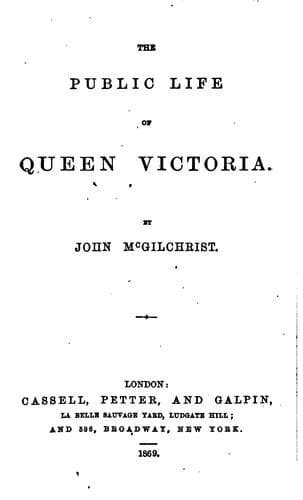
The Public Life of Queen VictoriaMcGilchrist, John
History
The Public Life of Queen Victoria
McGilchrist, John
Victoria, Queen of Great Britain, 1819-1901
The sight was one of the most thrilling ever seen in our metropolis, or in
our times. The gaunt and pallid forms, scarred features, and maimed and
mutilated limbs, brought home to the heart of the least sympathetic the
ravages of war, and the cost and guerdon of bravery. Many of those who
hobbled upon crutches, or walked painfully with the assistance of a stick,
wore upon their arms the emblems of mourning for some brother or near
relative, now reposing by the waters of the Euxine or the Bosphorus. To
each one of the wounded, whether officer or private, the Queen said some
kind word or asked some kindly question of him. Many of the poor fellows
were quite overcome by the tenderness of her compassion. Those officers
whose wounds rendered them unable to walk, were wheeled past in Bath
chairs. Sir Thomas Troubridge, who lost both feet at Inkerman, and who
has since died, was the first of these. The Queen, leaning over his chair,
handed him his medal with the most gracious gesture, and conferred upon
him the post of aide-de-camp to herself. Captains Sayer and Currie, who
were also wheeled past, received similar sympathy.
After the soldiers, came 450 sailors and marines, under Admiral Dundas,
who was the first to be decorated. The ceremony over, the non-commissioned
officers and men of all services dined in the riding-school, where they
were visited by the Queen, her husband, and their children.
[Sidenote: THE VOLUNTEER MOVEMENT.]
Closely and intimately allied with the intense warlike feeling which
prevailed throughout the period which we have been traversing, was the
rise, or rather the revival from our grandfathers' times, of the Volunteer
movement, in the winter of 1858-9. This very notable phenomenon of modern
days was entirely of spontaneous origin and popular outgrowth. At first
the authorities looked but coldly upon it--wisely so, we think--until it
evinced inherent elements of vitality and reality of purpose, and until it
appeared that it was something more than a mere passing impulse. It was
not until the 15th of May, 1859, that a circular from the Secretary for
War gave to the movement official sanction, in the form of an
authoritative permission by the Queen for the formation of volunteer
corps. Ere a twelvemonth had elapsed, 70,000 men had enrolled themselves
in England and Scotland; and before the end of the summer of 1860, that
number had swollen into 170,000. In many other and more emphatic modes the
Queen graciously accorded her own personal sanction and her warm and
approving recognition to the movement. At a special levee, held in March,
1859, all volunteer officers had the opportunity of being presented. At
the first meeting at Wimbledon of the National Rifle Association, in July,
1860, Her Majesty founded an annual prize, in value L250. At the same
meeting she fired the first shot, discharging a rifle, which had been
carefully adjusted to a target 400 yards distant. The cheers of the
Public-domain text, read in full here on John Shaqi.
Reviews
Reviews
No reviews yet
Be the first to share your thoughts on this work.
Elsewhere in the archive
Join the Discussion
Join the discussion
Sign in to leave a comment or review.
Sign InorCreate an account