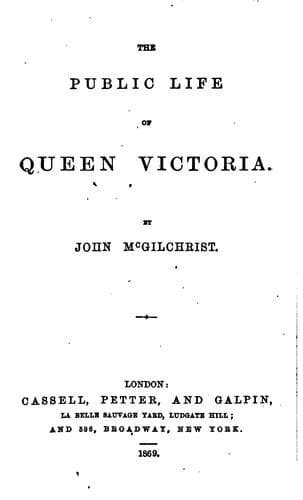
The Public Life of Queen VictoriaMcGilchrist, John
History
The Public Life of Queen Victoria
McGilchrist, John
Victoria, Queen of Great Britain, 1819-1901
I have caused you to be summoned at the present time in order that I
may acquaint you with my resolution in a matter which deeply concerns
the welfare of my people, and the happiness of my future life. It is
my intention to ally myself in marriage with the Prince Albert of
Saxe-Coburg and Gotha. Deeply impressed with the solemnity of the
engagement which I am about to contract, I have not come to this
decision without mature consideration, nor without feeling a strong
assurance that, with the blessing of Almighty God, it will at once
secure my domestic felicity and serve the interests of my country. I
have thought fit to make this resolution known to you at the earliest
period, in order that you may be apprised of a matter so highly
important to me and to my kingdom, and which, I persuade myself, will
be most acceptable to all my loving subjects.
The moment the Queen had read the Declaration, Lord Lansdowne rose and
asked, in the name of the Council, that "this most gracious and most
welcome communication might be printed." Leave was granted, and Her
Majesty left the room, the whole ceremony having occupied only two or
three minutes. The Duke of Cambridge followed his niece into the
ante-room, and warmly congratulated her. The Declaration appeared in the
next _Gazette_, whence it was copied into all the newspapers, and was
joyfully read and received over the whole land.
There were now important questions to be settled, in Parliament, in the
Council, and by the exercise of the Royal prerogative, as to the future
rank and station of the Prince. Such were--Should he be made a peer? as
had been the last consort of an English Queen, Prince George of Denmark,
the husband of Queen Anne, of whom the only good thing that can be said
is, that he accidentally made Arbuthnot, Pope's great friend and
fellow-labourer, his Court physician. The idea of being made a peer was
strenuously, sensibly, and successfully resisted by the Prince. Then there
were the practical questions of his naturalisation, the selection of his
Household, his position in the scale of precedence, and his income. So far
as the Prince legitimately could and did meddle with the solution of these
knotty points, he showed, when necessary, great sagacity, and a firmness
very wondrous in one so young. From the very moment of his betrothal, he
regarded himself as the custodian and guardian of his future wife's,
rather than his own, independent position and unfettered dignity. It was
not himself, but the husband of the Queen on behalf of whom he took a firm
line.
Public-domain text, read in full here on John Shaqi.
Reviews
Reviews
No reviews yet
Be the first to share your thoughts on this work.
Elsewhere in the archive
Join the Discussion
Join the discussion
Sign in to leave a comment or review.
Sign InorCreate an account