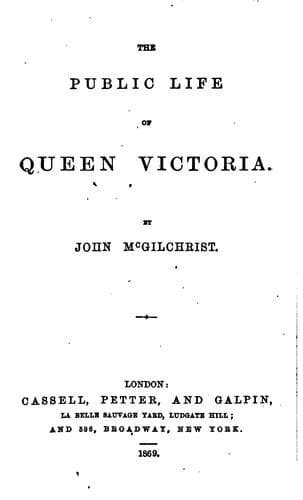
The Public Life of Queen VictoriaMcGilchrist, John
History
The Public Life of Queen Victoria
McGilchrist, John
Victoria, Queen of Great Britain, 1819-1901
Within the chapel, in which the altar was magnificently decorated and
laden with a profusion of gold plate, four state chairs were set, varying
in splendour according to the rank of the destined occupants, respectively
for Her Majesty, Prince Albert, the Queen Dowager, and the Duchess of
Kent. The Archbishops of Canterbury and York, and the Bishop of London,
having taken their places within the altar-rails, a flourish of trumpets
announced the procession of the bridegroom. As the Prince passed along,
the gentlemen greeted him with loud clapping of the hands, and the ladies
waved their handkerchiefs with at least equal enthusiasm.
[Sidenote: THE BRIDESMAIDS.]
In a few minutes the procession of the bride was announced by trumpets and
drums. It was of six or seven times the numerical strength of the
bridegroom's, and the beauty of the twelve bridesmaids, all daughters of
peers of the three highest grades, was specially commended. The Duchess of
Cambridge led by the hand her then child-daughter, the Princess Mary, "and
the mother of so beautiful a child was certainly not to be seen without
much interest." The Duchess of Kent appeared "disconsolate and
distressed;" while the Duke of Sussex, who was to give away the bride, was
"in excellent spirits." The Queen herself looked "anxious and excited, and
paler even than usual." She was dressed in a rich white satin, trimmed
with orange-flower blossoms. She wore a wreath of the same, over which was
a veil of rich Honiton lace, worn so as not to conceal her face. She wore
as jewels the Collar of the Order of the Garter, with a diamond necklace
and earrings. The bridesmaids were the Ladies Adelaide Paget, Sarah
Villiers, Frances Cowper, Elizabeth West, Mary Grimston, Eleanor Paget,
Caroline Lennox, Elizabeth Howard, Ida Hay, Catherine Stanhope, Jane
Bouverie, and Mary Howard.
After the conclusion of the marriage rite, the Queen hastily crossed to
the opposite side of the altar, and kissed the Queen Dowager, who was
standing there. She then took Prince Albert's hand, and passed down the
aisle. On the return to Buckingham Palace, it was observed that the
Prince, still retaining the Queen's hand in his own, whether by accident
or design, held it in such a way as to display the wedding-ring, which was
more solid than is usual in ordinary weddings. When the Queen had been led
into the palace by her husband, it was observed that her morning paleness
had entirely passed off, and that she entered her own halls with an open,
joyous, and slightly flushed countenance.
Public-domain text, read in full here on John Shaqi.
Reviews
Reviews
No reviews yet
Be the first to share your thoughts on this work.
Elsewhere in the archive
Join the Discussion
Join the discussion
Sign in to leave a comment or review.
Sign InorCreate an account