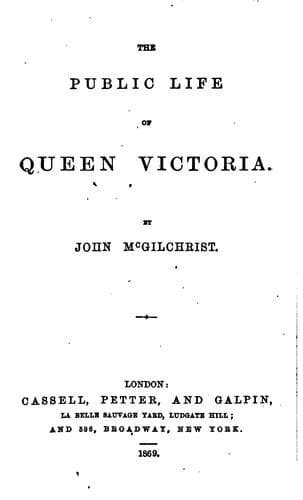
The Public Life of Queen VictoriaMcGilchrist, John
History
The Public Life of Queen Victoria
McGilchrist, John
Victoria, Queen of Great Britain, 1819-1901
The joy of the nation at the succession to the crown in the progeny of the
Queen and Prince Albert being thus secured, was excessive. Upon the
announcement of the happy accouchement, the nobility and gentry crowded to
the Palace to tender their dutiful inquiries as to the Sovereign's
convalescence. Amongst others, came the Lord Mayor and civic dignitaries
in great state. They felt peculiarly proud that the Prince should have
been born on Lord Mayor's day; in fact, just at the very moment when the
time-honoured procession was starting from the City for Westminster. In
memory of the happy coincidence, the Lord Mayor of the year, Mr. Pirie,
was created Sir John Pirie, Baronet. On the 4th of December, the Queen
created her son by Letters Patent, Prince of Wales and Earl of
Chester:--"And him, our said and most dear son, the Prince of the United
Kingdom of Great Britain and Ireland, as has been accustomed, we do
ennoble and invest with the said Principality and Earldom, by girding him
with a sword, by putting a coronet on his head, and a gold ring on his
finger, and also by delivering a gold rod into his hand, that he may
preside there, and direct and defend those parts." By the fact of his
birth as Heir-Apparent, the Prince indefeasibly inherited, without the
necessity of patent or creation, these dignities--the titles of Duke of
Saxony, by right of his father; and, by right of his mother, Duke of
Cornwall, Duke of Rothsay, Earl of Carrick, Baron of Renfrew, Lord of the
Isles, and Great Steward of Scotland.
[Sidenote: AN EMBASSY FROM FRANCE.]
In the early spring of 1840, the distinguished French statesman, M.
Guizot, came over to England, being sent hither by the French Premier,
Marshal Soult, on a special mission with reference to those complications
in the East, which culminated the following year in that war between the
Sultan Mahmoud and his vassal Mehemet Ali, in which British tars under
Stopford and "Charley Napier" played so conspicuous a part. His pacific
mission was a failure, and from its failure dates, first the loosening,
and then the severance, of the close relations which subsisted for eleven
years after 1830 between the Courts of St. James's and the Tuileries.
Public-domain text, read in full here on John Shaqi.
Reviews
Reviews
No reviews yet
Be the first to share your thoughts on this work.
Elsewhere in the archive
Join the Discussion
Join the discussion
Sign in to leave a comment or review.
Sign InorCreate an account