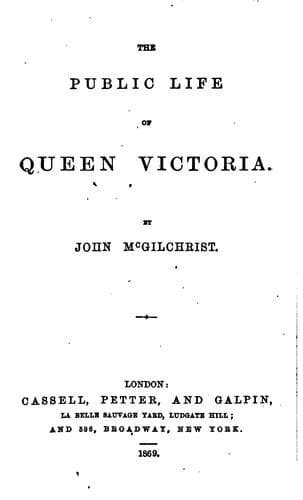
The Public Life of Queen VictoriaMcGilchrist, John
History
The Public Life of Queen Victoria
McGilchrist, John
Victoria, Queen of Great Britain, 1819-1901
Somewhat about the same time, Lord Lennox dined at Windsor Castle, at the
great banquet given on the Ascot Cup day. A magnificent dejeuner had been
served for luncheon on the course in Tippoo Sahib's tent. At the dinner in
the evening, the first thing which struck one who was a guest for the
first time on such an occasion, was the exact punctuality of the Queen
and Prince. Although necessarily fatigued with the bustle and excitement
of the day, they were in the drawing-room some minutes before the dinner
was announced, and after a courteous greeting to all the guests, proceeded
at once to dinner. Another observable peculiarity was that the Prince left
the table twenty minutes after the ladies. The banqueting-room on this
great occasion was St. George's Hall, splendid with its ceiling emblazoned
with the arms of the Knights of the Garter from the institution of the
order, and the portraits of our kings from James I. to George IV. At each
end of the hall, buffets, seventeen feet high and forty broad, were set.
They were of rich fretted Gothic framework, covered with crimson cloth,
and brilliant with massive gold plate. Immediately opposite the Queen was
set a pyramid of plate, its apex being the tiger's head captured at
Seringapatam, and comprising the "Iluma" of precious stones which Lord
Wellesley, the Governor-General of India, presented to George IV. The
table, which was laid for a hundred guests, extended the whole length of
the hall. All down the centre, epergnes, vases, cups, and candelabra were
ranged, the celebrated St. George's candelabrum being opposite Her
Majesty. The hall was splendidly illuminated, and two bands of the Guards
discoursed sweet music from a balcony. The Yeomen of the Guard stood on
duty at the entrance. The repast, which did ample justice to the merits of
the Queen's renowned _cuisinier_, Francatelli, was entirely served in gold
plate, and the attendance was so faultless that there was less bustle and
confusion than usually attend a repast shared by a party of ten or a
dozen. At a quarter to nine grace was said; and after the dessert and wine
had been placed on the table, the Lord Steward rose and proposed, without
remark, "The Queen." The Queen simply, when the toast had been drunk,
bowed her acknowledgments. After a brief pause, the health of Prince
Albert was drunk standing, as the Queen's had been, the band playing the
"Coburg March." At half-past nine the Queen rose, and, accompanied by the
Duchess of Kent, was followed by all the ladies to the drawing-room. In
about twenty minutes all the gentlemen followed. The Waterloo Chamber was
thrown open, and its rich historical and pictorial treasures were keenly
inspected by groups of the guests. Amongst others of its chief ornaments,
attention was concentrated on the swords of the Pretenders James and
Charles, Prince Rupert's coat of mail, and the magnificent shield, by
Cellini, presented by Francis I. to King Henry VIII., at the Field of the
Cloth of Gold.
Public-domain text, read in full here on John Shaqi.
Reviews
Reviews
No reviews yet
Be the first to share your thoughts on this work.
Elsewhere in the archive
Join the Discussion
Join the discussion
Sign in to leave a comment or review.
Sign InorCreate an account