“I should have put Ames wise about that,” Dicky told her. “It was
pretty hard to have Pidge hurt that way.”
“She brought home the news exultingly,” Miss Claes said. “Hurt, of
course--her old sorrow for Rufus Melton, but a compensating gladness,
too. You would have to be a woman, to feel exactly what it meant to
her. Pidge learned that day that you were close enough in sympathy to
share her work. That was light to her out of the depths.”
Dicky studied the shadowy face.
“Pidge accepts no revelations from the sacred writings,” Miss Claes
added. “Only messages of action count with her. Your action in Paris
freshened up her life--that you had been brave enough to help her with
her task. And how richly Pidge will pay!”
“It wasn’t hard to do, but hard to know that it was the thing to do.”
“All that matters now is that it is done. One crosses a goal, or one
does not. The rest is forgotten.”
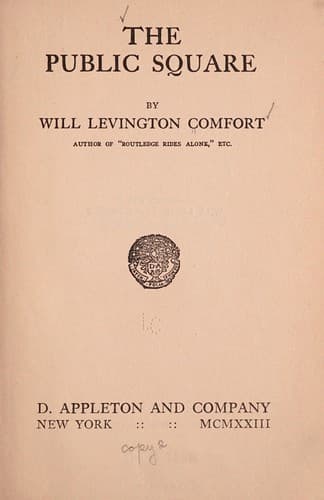
He told her of John Higgins and _The Public Square_; of his talk in the
morning and the day with the files. She inquired regarding details,
mechanical and commercial--her same old rational grasp upon materials.
Of course, he did not speak of John Higgins’ secret, nor of his own
possible purchase. It was a matter of mercantile tradition in the
Cobden house not to discuss an incompleted transaction; but he told her
of Pidge’s part at the time of the arrest of the editor’s old friend.
“John Higgins calls her ‘The Weekly,’” he added. “He says it was Pidge
who kept the paper going.”
Miss Claes turned to the fire to smile. Dicky didn’t notice. He was
lost in the problem of how John Higgins could give half-interest to
Pidge, and sell it to himself at the same time.... They were speaking
of India.
“Of course, I’ve arranged to go,” he said. “Nagar promises the story of
the age----”
“Nagar sent his message here for you, in case you did not receive word
from the _sepoy_ in Paris--‘No haste, but no delay.’”
He started. This house of Harrow Street seemed like an office of all
the world to him to-night.
* * * * *
“... The hardest part is with my people--for me to go away again,”
he was saying, a little later at the door. “Of course, they can’t
understand--my mother and aunt and sister. Everything looks all right,
except that--leaving them so soon again.”
“Perhaps I can help a little. I’ll go to them often--while you are
away.”
“That’s quite too good for me to think of,” he said, and told her of
Pidge’s call. “Why, Miss Claes, I haven’t known what it meant to be
rested and straightened out like this--since Ahmedabad,” he said at
last.
Her hand was raised before him:
“Don’t think about it. Don’t analyze. Just--go to them--and come back
when you can. This also is your home always.”
XXXIX
SEVEN FLAWLESS DAYS
Public-domain text, read in full here on John Shaqi.
Reviews
Reviews
No reviews yet
Be the first to share your thoughts on this work.
Elsewhere in the archive
Join the Discussion
Join the discussion
Sign in to leave a comment or review.
Sign InorCreate an account