He walked slowly out of the shade of the trees. With each step, his
blood chilled a little, in spite of noon heat. He thought of _The
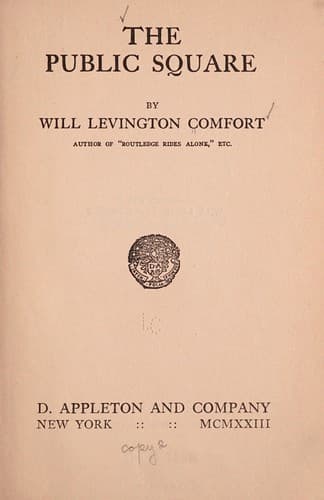
Public Square_, of Pidge Musser at the desk there, of Harrow Street.
Death had to come some time, but life wasn’t boring him just now. The
sunlight of the open stretch stung his eyes with great weariness. The
deep voice called from behind:
“Stay, my pupil!”
Dicky halted and returned, looking down into the apparently guileless
and desireless eye. “Alms for the temple in Cawnpore,” the lips intone.
“By all means, father,” the other said, no visible change upon his
face, as he placed in the palm of the beggar several bits of silver
from his purse. In the burning day again, he lifted a tired smile to
the sun. No true mystic, perhaps, but what had this man seen in the
crystals?
XLII
LALA RELU RAM
NAGAR took him by the hand at the railway station in Amritsar on the
evening of the ninth of April, 1919. The need for many words seemed
past; there was quiet gladness. Dicky took up his quarters in the
_Golden Temple Inn_. Under the lights at the entrance, as he passed
in with Nagar, groups of Mohammedans and Hindus stood together, with
self-conscious but eager shows of mutual friendship, and the American
rubbed his eyes.
If there was one thing in India that could be counted upon like
Government itself, it was the mutual hatred of these two great
divisions of native life. Dicky had heard in recent days much of
the swift breaking down of these barriers, under the influence of
Mahatma-ji, but he had seen no example of it working out like this
under the lights of the Inn.
“But what do the English think when they see the Hindu and Moslem
_kowtowing_ to each other--as at the door below when we came in?” Dicky
inquired.
“The Deputy Commissioner, the highest English civilian of Amritsar,
looked upon a similar spectacle to-day,” Nagar said. “I did not hear
him, but he is reported to have remarked, ‘There’s going to be a row
here,’ and drank much cold soda water.”
“What is your work here, Nagar?”
“I have been working among the students at the college of Lahore, and
now here in Amritsar, working with the young men and women.”
“Preaching Gandhi’s sort of peace?”
“Yes,” said Nagar.
“I still wonder that the English don’t ‘get’ the Little Man, Nagar.”
“The Government regards him as harmless because he speaks of
Soul-force. It deals with precedents; Mahatma-ji with ideals----”
“You think the Government will arrest him sooner or later?”
“Oh, yes.”
“Won’t that stop or hurt the work?”
“I remember,” said Nagar, “hearing the school children in New York
sing, ‘John Brown’s body lies a-moldering in the grave, but his Soul
goes marching on.’ A spiritual beginning never stops. Mahatma-ji has
already brought his few spiritual principles into matter, into action.”
“Tunnel,” said Dicky.
Public-domain text, read in full here on John Shaqi.
Reviews
Reviews
No reviews yet
Be the first to share your thoughts on this work.
Elsewhere in the archive
Join the Discussion
Join the discussion
Sign in to leave a comment or review.
Sign InorCreate an account