“Oh, yes, all is well with me,” he said. “I have been sorry to leave
you so much alone in the north.... Yes,” he added, “it was harder
for you than for me--the test that day on the tennis court. You were
brave, my friend. I knew all was well--when the instant passed and you
remained silent.”
“How do you mean--all was well?”
“I knew that the message of India would get to America--since you did
not spoil it by defending me.”
Nagar turned to Miss Claes, adding:
“I saw the fury and fright rise in his eyes, and all the impulses
of ethics of the West--then silence over all. It was as if we were
cemented----”
Dicky remembered that last word afterward.
As he moved about and talked, he was vaguely conscious of watching the
other two together. It was as if Pidge would want to hear of every
gesture and detail. Miss Claes was less Indian here than in Harrow
Street. There he had thought of her as belonging to the East; here she
seemed of the West. Something of the composure he had noted on the
tennis court had come to stay in Nagar’s eyes. As moments passed, Dicky
knew that they contained deep vitalities of meaning that would appear
in coming days.
It was as if his limitations were being stretched, but by consummate
hands. There was repeatedly brought to him, from them, something that
he refused to hear or dwell with: that he had done well, that he was
deeply approved of in their sight; that there was much more to take
place between them as a group, even though they were to stay in Asia,
and he was leaving for The States.... Then all faces turned, and in the
doorway stood the Little Man.
No one spoke, but to Richard Cobden it was one moment of his life
that he thought of as religious. Mahatma-ji came in between them, and
Dicky felt the old urge somehow to help with his hands; the sense,
too, of all India thronging, whispering around them. For a moment the
four had been standing in silence, when they heard the _sweep_ of bare
slow feet in the hall, and now an old dark face was in the doorway, a
smile serene as nothing else on earth but the Hills themselves--a dark
wrinkled old face, and she came forward and stood very low and little
in the midst of them--Gandhi’s comrade.
* * * * *
In San Francisco, waiting for the departure of his train east, a card
was sent up to Cobden’s hotel room. It was from Chris Heidt, the
managing editor of his former newspaper connection.
“Hello, Cobden. Just noticed you were off ship. What did you bring
back?”
Dicky reflected. “The story of Amritsar,” he said finally.
“Amritsar, what’s that?”
“The first big story I ever ran across. I feel like one of Job’s
servants, who said he alone remained to make a report.”
Mr. Heidt had been much on trains during the past few days, and had
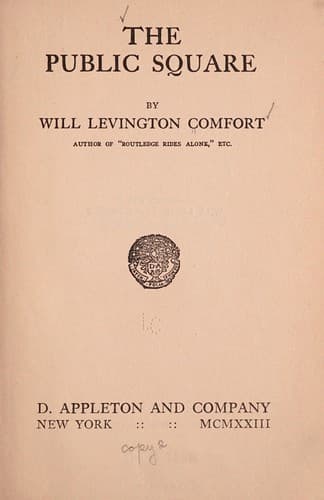
missed the fact, so far, that _The Public Square_ had begun to publish
the story.
“Not going to bury it in a weekly, are you?”
Public-domain text, read in full here on John Shaqi.
Reviews
Reviews
No reviews yet
Be the first to share your thoughts on this work.
Elsewhere in the archive
Join the Discussion
Join the discussion
Sign in to leave a comment or review.
Sign InorCreate an account