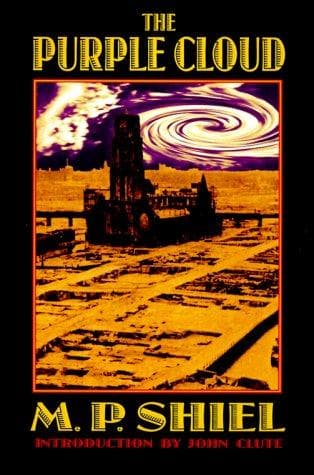
Apocalyptic fantasies; End of the world -- Fiction; Natural disasters -- Fiction; Science fiction
seaweed, and no bodies, and nothing but a concave, large esplanade of
seaweed. She was a ship of probably 1,500 tons, three-masted, and a
sailer. I got aft (for I had on thick outer babooshes), and saw that
only four of the companion-steps remained; by a small leap, however, I
could descend into that desolation, where the stale sea-stench seemed
concentrated into a very essence of rankness. Here I experienced a
singular ghostly awe and timorousness, lest she should sink with me, or
something: but striking matches, I saw an ordinary cabin, with some
fungoids, skulls, bones and rags, but not one cohering skeleton. In the
second starboard berth was a small table, and on the floor a thick
round ink-pot, whose continual rolling on its side made me look down;
and there I saw a flat square book with black covers, which curved
half-open of itself, for it had been wet and stained. This I took, and
went back to the _Speranza_: for that ship was nothing but an emptiness,
and a stench of the crude elements of life, nearly assimilated now to
the rank deep to which she was wedded, and soon to be absorbed into its
nature and being, to become a sea in little, as I, in time, my God,
shall be nothing but an earth in little.
During dinner, and after, I read the book, with some difficulty, for it
was pen-written in French, and discoloured, and it turned out to be the
journal of someone, a passenger and voyager, I imagine, who called
himself Albert Tissu, and the ship the _Marie Meyer_. There was nothing
remarkable in the narrative that I could see--common-place descriptions
of South Sea scenes, records of weather, cargoes, and the like--till I
came to the last written page: and that was remarkable enough. It was
dated the 13th of April--strange thing, my good God, incredibly
strange--that same day, twenty long years ago, when I reached the Pole;
and the writing on that page was quite different from the neat look of
the rest, proving immoderate excitement, wildest haste; and he heads it
'_Cinq Heures_,'--I suppose in the evening, for he does not say: and he
writes: 'Monstrous event! phenomenon without likeness! the witnesses of
which must for ever live immortalised in the annals of the universe, an
event which will make even Mama, Henri and Juliette admit that I was
justified in undertaking this most eventful voyage. Talking with Captain
Tombarel on the poop, when a sudden exclamation from him--"_Mon Dieu!_"
His visage whitens! I follow the direction of his gaze to eastward! I
behold! eight kilomètres perhaps away--, _ten monstrous waterspouts_,
reaching up, up, high enough--all apparently in one straight line, with
intervals of nine hundred _mètres_, very regularly placed. They do not
wander, dance, nor waver, as waterspouts do; nor are they at all
lily-shaped, like waterspouts: but ten hewn pillars of water, with
uniform diameter from top to bottom, only a little twisted here and
there, and, as I divine, fifty _mètres_ in girth. Five, ten, stupendous
Public-domain text, read in full here on John Shaqi.
Reviews
Reviews
No reviews yet
Be the first to share your thoughts on this work.
Elsewhere in the archive
Join the Discussion
Join the discussion
Sign in to leave a comment or review.
Sign InorCreate an account