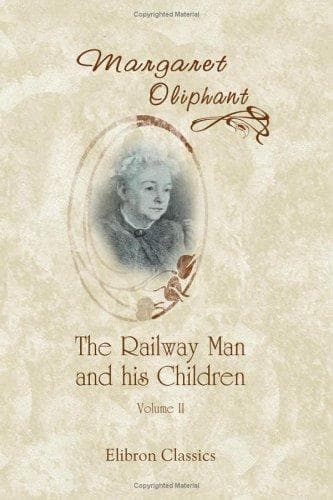
The Railway Man and His ChildrenOliphant, Mrs. (Margaret)
General
The Railway Man and His Children
Oliphant, Mrs. (Margaret)
Children of the rich -- Fiction; Families -- Fiction; Forgery -- Fiction; Scotland -- Fiction; Social classes -- Fiction
his wife’s taste and superior knowledge, while she was inspecting those
treasures which he declared he did not understand. But he did understand
bric-a-brac, it turned out, much better than Evelyn did, though perhaps
his taste in pictures was not so pure.
Thus the days passed by; and though those pleasures depended very much
on the depth of Mr. Rowland’s purse, they could scarcely be called
vulgar pleasures, although Evelyn sometimes at the end of the day
blushed to think how she had enjoyed herself. Was it the fact of
spending money, an operation which in itself seemed to give pleasure to
her husband, or was it the acquisition of so many valuable and beautiful
things which was delightful? It was complicated, as everything human
is, with the contrast of previous life, with the pleasure of pleasing
him by being pleased herself, even perhaps a little by the obsequious
respect by which their progress was attended. This was a poor view, and
we are poor creatures, the best of us--for there was something even in
that. As for the purchases themselves, Evelyn knew that a cracked pot, a
scrap of an old picture, a bit of clumsy carving, was capable of giving
quite as much pleasure as all the treasures of art which accumulated in
their rooms at the hotel. Happily there is compensation in all things,
and the highest of all delights, in bric-a-brac at least, is not to him
who buys whatever strikes his fancy, regardless of expenses, but to him
who “picks up” an unexpected gem, for a few pence or shillings, in some
ignoble corner where no such treasure could be suspected to be.
And they dined out in the evenings, at the Leightons, of course, and at
other places where the great railway man found himself a sort of lion,
to his great astonishment, where he expected modestly to be received,
chiefly on his wife’s account, in spheres which were not his. In this
point of view Mr. Rowland was delighted, and Evelyn was as proud of her
husband as he could be of her, which was saying a great deal. Like many
other people in this world, Rowland was not in the least vain of the
real work he had done. He was aware that he had been very lucky in many
things, in the means he had employed, in the curious natural facilities
which always came in his way; but his own skill and patience and thought
did not seem to come into his mind as deserving of special distinction.
“Oh, of course, since it was my business, I tried to do it the best I
could,” he said, as if that were the most natural thing in the world. It
was his assistants who were the wonderful fellows; he was so fortunate
in always getting hold of the best men; no man but had been true to him,
as Brutus says. Evelyn sat by and listened with such light in her eyes
that her friend, Lady Leighton, looked at her in wonder. “Why, you are
in love with him!” said that woman of the world.
Public-domain text, read in full here on John Shaqi.
Reviews
Reviews
No reviews yet
Be the first to share your thoughts on this work.
Elsewhere in the archive
Join the Discussion
Join the discussion
Sign in to leave a comment or review.
Sign InorCreate an account