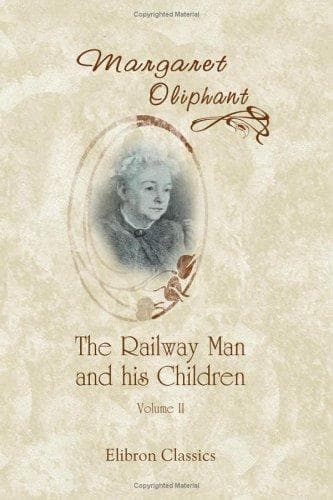
The Railway Man and His ChildrenOliphant, Mrs. (Margaret)
General
The Railway Man and His Children
Oliphant, Mrs. (Margaret)
Children of the rich -- Fiction; Families -- Fiction; Forgery -- Fiction; Scotland -- Fiction; Social classes -- Fiction
“Well!--you don’t know society as I do. You’ve spent your life in
primitive countries, where men fly at each other’s throats when they
disapprove of each other. We don’t do that here. We carry on our
relations all the same. Sometimes, however, we speak very plainly, I am
glad to say. Ned Saumarez knows exactly what I think of him, but he
comes to see me as if we were the dearest of friends.”
“I don’t understand society,” said Rowland, “and I don’t think I should
ever know that part of it. How is anybody to know which you prefer, the
good or the bad, if you treat them just the same?”
“Oh, everybody knows what I think of him, including himself,” said
Madeline, lightly; “that’s one of our refinements. And so you are going
to have Rose and Eddy to visit you in the country. You are a couple of
bold people--with a boy and a girl of your own. Of course there will be
fallings in love.”
Rowland laughed again, opening his mouth in simple enjoyment of the
joke, as he took it. “I think I can answer for my two,” he said.
“Oh, you can’t answer for anybody!” said Lady Leighton, somewhat
sharply, “Rose is a girl of the period, and scorns that kind of
thing--so does my Mabel, save the mark! They are both going to do all
sorts of things as soon as they are out--walk the hospitals! I don’t
know what absurd projects they have. But Eddy, I warn you, is a _mauvais
sujet_, Evelyn. He is like his father. He makes love to everybody. I
don’t know what age Miss Rowland is----”
“Eighteen,” said her father.
Lady Leighton threw up her hands. “His natural prey! And she has been
brought up in the country, I suppose, and believes anything that is said
to her----”
“She has been brought up,” said Rowland, a little displeased with the
turn the conversation was taking, “in Glasgow, which is a very different
thing from the country, and perhaps not so much given to the innocence
of faith.”
“Oh!” said Lady Leighton, making a dead pause. She had not the least
idea how a girl could be brought up in Glasgow, any more than if it had
been Timbuctoo. The country she comprehended: town she comprehended--but
Glasgow! A “smart” lady’s information stops long before it comes to such
a point as that.
“Perhaps,” said Evelyn, troubled by all this, “I have been imprudent. It
is awkward, anyhow, to have these young people coming to us so soon,
when we are scarcely settled; but it is hard to say no, when one is
appealed to, for the good of others.”
“I hope,” said Rowland, “it is an appeal you never will refuse. It
shocks me rather to hear you now discussing your future guests. Don’t
they become sacred as soon as you invite them, like the strangers in a
Bedouin’s tent? That’s our old Scotch way.”
“Mr. Rowland, you are a darling,” said Lady Leighton, “quite too great a
darling, Evelyn, for this wicked world. I am so glad you have invited
me! But is it not the Scotch way to tear one into little pieces after
one is gone? The balance must be kept straight somehow.”
Public-domain text, read in full here on John Shaqi.
Reviews
Reviews
No reviews yet
Be the first to share your thoughts on this work.
Elsewhere in the archive
Join the Discussion
Join the discussion
Sign in to leave a comment or review.
Sign InorCreate an account