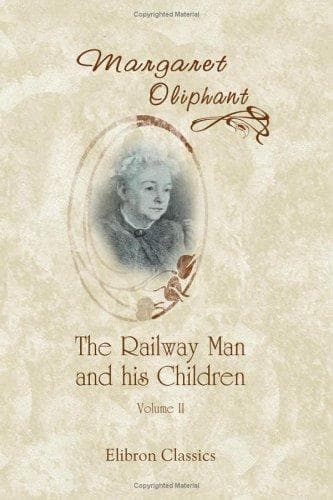
The Railway Man and His ChildrenOliphant, Mrs. (Margaret)
General
The Railway Man and His Children
Oliphant, Mrs. (Margaret)
Children of the rich -- Fiction; Families -- Fiction; Forgery -- Fiction; Scotland -- Fiction; Social classes -- Fiction
But this was set down to modesty, or fatigue, or crossness, which
unfortunately had grown of late to be a recognised quality of Archie.
And Mr. Rowland himself took down a brace of grouse to the Manse next
morning, a proud father handing out “my son’s birds,” as if Archie had
been the finest shot in the world. But this was not Archie’s fault, who
knew nothing of the transaction. He managed to be able to carry his gun
like other feeble sportsmen after that terrible initiation. Thus both
Mr. Rowland’s children learned to adapt themselves to the duties of
their new sphere.
CHAPTER XXII.
Rowland’s ideas of the absence of society in his new home were
confounded by the number of visits his wife received within the first
six weeks of their stay at Rosmore. It had, I have no doubt, been noised
abroad that the wife of the great railway man was, in the loose but
convenient phraseology of the time, “a lady,” and that there was
therefore no appreciable peril to the gentility of her caller, from
making her acquaintance. Lady Jean, of course, was one of the first to
call upon her brother’s tenant. Her arrival was attended by
circumstances of which James Rowland could never think afterwards
without shame and humiliation. Indeed it all but happened to him to turn
the little shabby old lady who was trudging through the woods in short
petticoats and a waterproof to the kitchen door as the natural entrance.
Lady Jean was a little woman of about fifty, who had long ceased to
take the least pride in her appearance, or to care what people thought
on the subject. This last presumption was of course quite unnecessary in
the parish of Rosmore, where everybody knew who she was, and where, had
she gone about in cloth of gold, it would have made no particular
difference. She wore tweed accordingly with the most reckless
indifference to quality (I believe the quality was generally good--it
came in bales from Romans and Paterson, which the Glasgow shopkeepers
thought disloyal to them, and unpatriotic)--one society gown after
another being manufactured for her as need arose; and she was fond of
giving a gown-piece to any girl that might strike her fancy, walked
well, and was, as she expressed it in pregnant Scotch, “purpose-like.”
This is not to say that Lady Jean could not be every inch the Earl’s
sister when occasion demanded, and strike terror into the Radical
multitude, or that she did not possess, and occasionally wear, a
wardrobe more fitted to her condition.
Public-domain text, read in full here on John Shaqi.
Reviews
Reviews
No reviews yet
Be the first to share your thoughts on this work.
Elsewhere in the archive
Join the Discussion
Join the discussion
Sign in to leave a comment or review.
Sign InorCreate an account