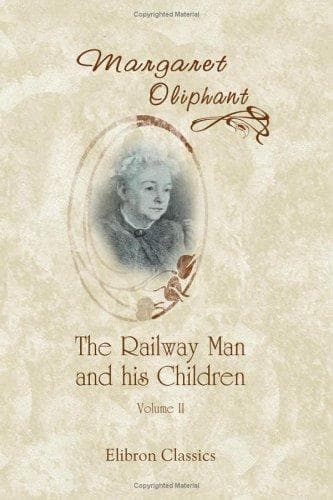
The Railway Man and His ChildrenOliphant, Mrs. (Margaret)
General
The Railway Man and His Children
Oliphant, Mrs. (Margaret)
Children of the rich -- Fiction; Families -- Fiction; Forgery -- Fiction; Scotland -- Fiction; Social classes -- Fiction
“I know more about that than you do,” said Eddy. “You shan’t, I can tell
you: for one thing, I mean to dance with you myself all the night. We go
so well together, you and I. And I know how to square the
chaperons--especially with _her_. She won’t dare to say anything against
me.”
“If you think that I would let her interfere!” said Marion; “but you are
not to get things all your own way. I’ll just dance with whom I
please--and maybe not with you at all.”
“We’ll see about that,” said Eddy.
“Yes, we’ll see about it,” cried the girl, and then there was a great
laugh, as if this had been the wittiest observation in the world.
If Evelyn did not hear this, she saw it, with all the advantages of
spectatorship seeing more in the game than the actors themselves were
aware of, probably more (which is the drawback of spectatorship), than
had any existence. Would James think she was in the plot? Would he
believe it was of her invention, or that she had carried it out
consciously for the advantage of the others? In her first hurried
discovery of this aspect of affairs, it did not occur to Evelyn that
James was a man of an old-fashioned type, who believed in true love, and
might sympathize with his children if they were impressed by such an
influence, more than with any wise counsel or hesitation as to means.
She herself, whatever her sentiments might be, belonged to a world more
moved by conventional laws. She thought that she saw him with reproach
in his face, looking at her as he never had done, severely,
reproachfully--he to whom she owed so much, not only wealth and
consideration, but tenderness and kindness, and absolute trust--Trust!
that was the greatest of all: and he would think that she had betrayed
him.
Mr. Johnson, so-called of St. Chad’s, finished the substantial part of
his banquet about this moment, and with a glance at the pastry which was
visible, laid out upon the white cloth, stirred a little in his nest of
heather, making the long spikes of the ling rustle, and calling forth
again that pungent sweetness of the gale. Mrs. Rowland, to whom
incivility was impossible, and who, though doubtful, still felt it more
comprehensible that a distinguished don might be of evil appearance
than that Eddy Saumarez could have told her a lie, turned towards him to
see what were his wants. He was not without an ambition to shine in
polite conversation, and Evelyn’s was not the aspect to discourage such
attempts. He said, waving his hand as if to include the whole party,
“This is a very cheerful way, if you will let me say so, of meeting for
the first time.”
“Yes?” said Evelyn, interrogatively.
“It’s a beautiful scene,” said the stranger, “and the pie was excellent.
What a nice way for ladies to join in sport, when the men’s tired and
ready to be tumbled over at the first shot--ha, ha,--as seems to be the
case, ma’am, in your vicinity.”
“Sir?” said Mrs. Rowland.
Public-domain text, read in full here on John Shaqi.
Reviews
Reviews
No reviews yet
Be the first to share your thoughts on this work.
Elsewhere in the archive
Join the Discussion
Join the discussion
Sign in to leave a comment or review.
Sign InorCreate an account