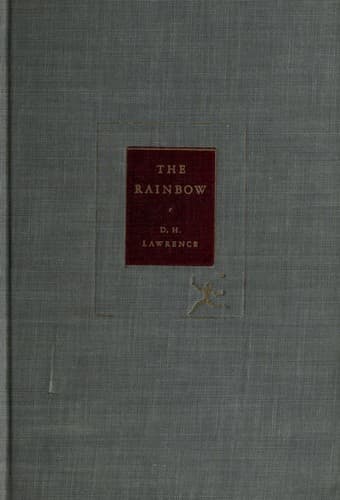
Domestic fiction; Family -- England -- Midlands -- Fiction; Midlands (England) -- Fiction
He was in a state of violent irritation against her. Partly he was
ashamed of his love for these things; he hid his passion for them. He
was ashamed of the ecstasy into which he could throw himself with these
symbols. And for a few moments he hated the lamb and the mystic
pictures of the Eucharist, with a violent, ashy hatred. His fire was
put out, she had thrown cold water on it. The whole thing was
distasteful to him, his mouth was full of ashes. He went out cold with
corpse-like anger, leaving her alone. He hated her. He walked through
the white snow, under a sky of lead.
And she wept again, in bitter recurrence of the previous gloom. But her
heart was easy—oh, much more easy.
She was quite willing to make it up with him when he came home again.
He was black and surly, but abated. She had broken a little of
something in him. And at length he was glad to forfeit from his soul
all his symbols, to have her making love to him. He loved it when she
put her head on his knee, and he had not asked her to or wanted her to,
he loved her when she put her arms round him and made bold love to him,
and he did not make love to her. He felt a strong blood in his limbs
again.
And she loved the intent, far look of his eyes when they rested on her:
intent, yet far, not near, not with her. And she wanted to bring them
near. She wanted his eyes to come to hers, to know her. And they would
not. They remained intent, and far, and proud, like a hawk’s naïve and
inhuman as a hawk’s. So she loved him and caressed him and roused him
like a hawk, till he was keen and instant, but without tenderness. He
came to her fierce and hard, like a hawk striking and taking her. He
was no mystic any more, she was his aim and object, his prey. And she
was carried off, and he was satisfied, or satiated at last.
Then immediately she began to retaliate on him. She too was a hawk. If
she imitated the pathetic plover running plaintive to him, that was
part of the game. When he, satisfied, moved with a proud, insolent
slouch of the body and a half-contemptuous drop of the head, unaware of
her, ignoring her very existence, after taking his fill of her and
getting his satisfaction of her, her soul roused, its pinions became
like steel, and she struck at him. When he sat on his perch glancing
sharply round with solitary pride, pride eminent and fierce, she dashed
at him and threw him from his station savagely, she goaded him from his
keen dignity of a male, she harassed him from his unperturbed pride,
till he was mad with rage, his light brown eyes burned with fury, they
saw her now, like flames of anger they flared at her and recognized her
as the enemy.
Very good, she was the enemy, very good. As he prowled round her, she
watched him. As he struck at her, she struck back.
He was angry because she had carelessly pushed away his tools so that
they got rusty.
“Don’t leave them littering in my way, then,” she said.
“I shall leave them where I like,” he cried.
Public-domain text, read in full here on John Shaqi.
Reviews
Reviews
No reviews yet
Be the first to share your thoughts on this work.
Elsewhere in the archive
Join the Discussion
Join the discussion
Sign in to leave a comment or review.
Sign InorCreate an account