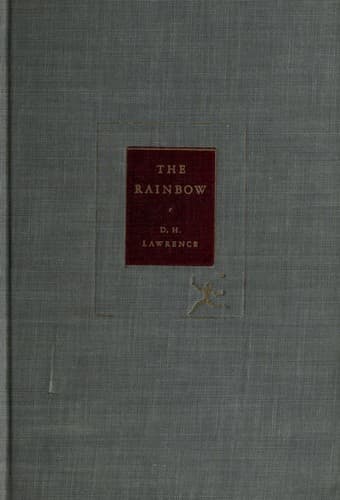
Domestic fiction; Family -- England -- Midlands -- Fiction; Midlands (England) -- Fiction
She made a new illusion of school. Miss Grey, the headmistress, had a
certain silvery, school-mistressy beauty of character. The school
itself had been a gentleman’s house. Dark, sombre lawns separated it
from the dark, select avenue. But its rooms were large and of good
appearance, and from the back, one looked over lawns and shrubbery,
over the trees and the grassy slope of the Arboretum, to the town which
heaped the hollow with its roofs and cupolas and its shadows.
So Ursula seated herself upon the hill of learning, looking down on the
smoke and confusion and the manufacturing, engrossed activity of the
town. She was happy. Up here, in the Grammar School, she fancied the
air was finer, beyond the factory smoke. She wanted to learn Latin and
Greek and French and mathematics. She trembled like a postulant when
she wrote the Greek alphabet for the first time.
She was upon another hill-slope, whose summit she had not scaled. There
was always the marvellous eagerness in her heart, to climb and to see
beyond. A Latin verb was virgin soil to her: she sniffed a new odour in
it; it meant something, though she did not know what it meant. But she
gathered it up: it was significant. When she knew that:
x2 – y2 = (x + y) (x – y)
then she felt that she had grasped something, that she was liberated
into an intoxicating air, rare and unconditioned. And she was very glad
as she wrote her French exercise:
“_J’ai donné le pain à mon petit frère_.”
In all these things there was the sound of a bugle to her heart,
exhilarating, summoning her to perfect places. She never forgot her
brown “Longman’s First French Grammar”, nor her “Via Latina” with its
red edges, nor her little grey Algebra book. There was always a magic
in them.
At learning she was quick, intelligent, instinctive, but she was not
“thorough”. If a thing did not come to her instinctively, she could not
learn it. And then, her mad rage of loathing for all lessons, her
bitter contempt of all teachers and schoolmistresses, her recoil to a
fierce, animal arrogance made her detestable.
She was a free, unabateable animal, she declared in her revolts: there
was no law for her, nor any rule. She existed for herself alone. Then
ensued a long struggle with everybody, in which she broke down at last,
when she had run the full length of her resistance, and sobbed her
heart out, desolate; and afterwards, in a chastened, washed-out,
bodiless state, she received the understanding that would not come
before, and went her way sadder and wiser.
Ursula and Gudrun went to school together. Gudrun was a shy, quiet,
wild creature, a thin slip of a thing hanging back from notice or
twisting past to disappear into her own world again. She seemed to
avoid all contact, instinctively, and pursued her own intent way,
pursuing half-formed fancies that had no relation to anyone else.
Public-domain text, read in full here on John Shaqi.
Reviews
Reviews
No reviews yet
Be the first to share your thoughts on this work.
Elsewhere in the archive
Join the Discussion
Join the discussion
Sign in to leave a comment or review.
Sign InorCreate an account