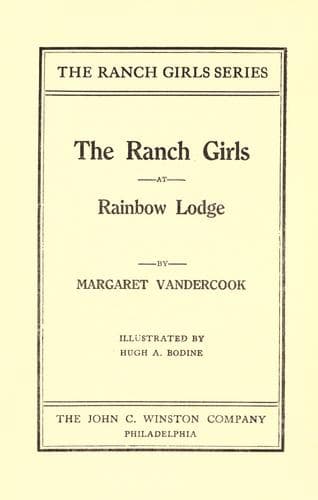
The Ranch Girls at Rainbow LodgeVandercook, Margaret
General
The Ranch Girls at Rainbow Lodge
Vandercook, Margaret
Ranch life -- Juvenile fiction; Western stories; Young women -- Juvenile fiction
Laska and Olive had a tent of their own. In it they lived for some time,
rarely speaking to one another. Nobody was unkind to her and for some
reason Laska left her alone. It was growing bitterly cold and the old
woman used to sit smoking all day by the fire, either in her own wigwam
or one nearby. She did not try to watch Olive, knowing that she could
not get away. Laska had told her that she should never leave the Indians
again; that they would return no more to the neighborhood of the white
men and Olive seemed quietly to accept her fate. Even Laska, who had
trained the girl in her own school of silence, was deceived by her. She
thought that Olive no longer cared enough to go back to dare the perils
of the trip.
At first it did appear utterly impossible to Olive. She had not the
faintest idea in what direction she and Laska had traveled and on
arriving among the Indians, her pony had been taken away from her. She
had no food except the little bit she was allowed each day, barely
enough to live on and knew that at any time now, the swift and bitter
snowstorms of the prairies might fall. Any traveler caught out in one of
them would surely perish and not be found until the snow melted.
There were many hours, when Olive thought she would run away anyhow and
take whatever fate came to her. But the memory of Jack, and Jean and
Frieda, Cousin Ruth and Rainbow Lodge sustained her. A little time
before and she had not known any happiness. Now the thought of the joy
she would feel if she ever got home again, gave her patience and courage
to wait.
Few of the older Indians paid much attention to the captive. Whatever
story old Laska had told them, they had accepted without question. They
spoke very little English and rarely stirred, except when the men went
off on long hunting expeditions to return with whatever deer they
managed to slay.
Olive had only one friend, one person, with whom she talked in the weeks
she spent in the Indian camp. This was Carlos, a young Indian boy, about
twelve years old. He was as slender and straight as a young pine tree,
the fastest runner, the best rider and shot in the tribe. She had paid
little attention to the boy at first, but he followed her like a shadow.
Often when she came out of her tent, she would find him sitting like a
brown image on the cold ground. The boy was like an Eskimo and appeared
to feel neither hunger nor frost.
One day Olive set out for a walk. She did not wish Carlos to go with
her, but before she had gone many rods the boy appeared at her side and
quietly marched beside her, looking neither to the right nor the left.
"Go back, Carlos," Olive commanded quietly.
The boy shook his head. "You travel not alone over the prairies, you do
not know your way," he answered stolidly.
Olive's patience gave out. She seized the boy by the shoulders, tears
came into her soft black eyes and her face quivered. "You are hired to
spy on me, Carlos," she said accusingly. "I thought I had one friend in
you."
Public-domain text, read in full here on John Shaqi.
Reviews
Reviews
No reviews yet
Be the first to share your thoughts on this work.
Elsewhere in the archive
Join the Discussion
Join the discussion
Sign in to leave a comment or review.
Sign InorCreate an account