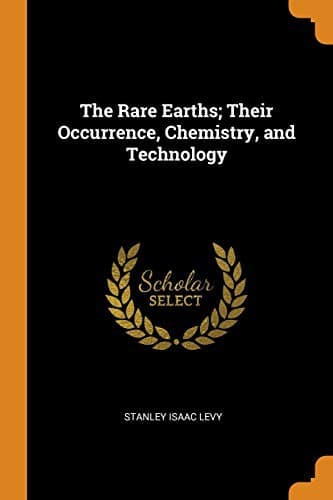
The Rare Earths: Their Occurrence, Chemistry, and TechnologyLevy, Stanley Isaac
Science
The Rare Earths: Their Occurrence, Chemistry, and Technology
Levy, Stanley Isaac
Rare earths
The homogeneity of ytterbia was questioned by Auer von Welsbach[355] in
1906; by fractionation of the ammonium double oxalates, that author
isolated the oxides of two new elements, for which he proposed the names
Aldebaranium and Cassiopeium. By fractionation of the nitrates from
nitric acid solution, Urbain[356] arrived at the same result, and
proposed the names Ytterbium (Neoytterbium) and Lutecium, which have
been adopted by the International Committee. The latter author,
employing the same method in the fractionation of the gadolinite earths,
has recently obtained very strong evidence of the existence in this
group of another element, for which he proposes the name Celtium;[357]
the discovery, however, awaits confirmation.
[355] _Monats._ 1906, ~27~, 935; 1908, ~29~, 121.
[356] _Compt. rend._ 1907, ~145~, 759.
[357] _Ibid._ 1911, ~152~, 141.
SEPARATION
In the separation of the yttrium elements, methods based on differences
in electropositive character are of much greater importance than in the
separation of the cerium and terbium groups, and the method of nitrate
fusion has been very largely employed even in comparatively recent work.
This method, which was introduced by Berlin in 1860, has been of great
value in the separation of yttrium and the ytterbium elements from the
erbium group; it was employed in the isolation of ytterbium by Marignac,
and of scandium by Nilson.
If a concentrated solution of the nitrates be evaporated down, and the
syrupy residue subjected to gradually increasing temperature, the
nitrates of the ytterbium elements and scandium are converted first into
the basic nitrates; at somewhat higher temperatures the erbium salts are
decomposed, whilst yttrium nitrate and the nitrates of any cerium
elements present are the last to break up. If the mixture of basic and
neutral nitrates be dissolved in boiling water, the former, being less
soluble, crystallise out on cooling, and may be separated by this means,
the process being repeated with the filtrate containing the unchanged
nitrates. In this way, the weakly basic scandia and ytterbia quickly
collect in the first fractions, whilst the oxides of the erbia group are
easily separated from the more strongly basic yttria. The presence of
the intermediate terbium group renders the process much less easily
workable.
The process may be modified by raising the temperature to such an extent
that the soluble basic nitrates are converted into insoluble superbasic
nitrates, the temperatures at which this change occurs increasing from
element to element as the positive character becomes more marked; the
mixture of basic and superbasic salts is then extracted with dilute
nitric acid which leaves that latter undissolved and removes the more
positive elements in solution.
Public-domain text, read in full here on John Shaqi.
Reviews
Reviews
No reviews yet
Be the first to share your thoughts on this work.
Elsewhere in the archive
Join the Discussion
Join the discussion
Sign in to leave a comment or review.
Sign InorCreate an account