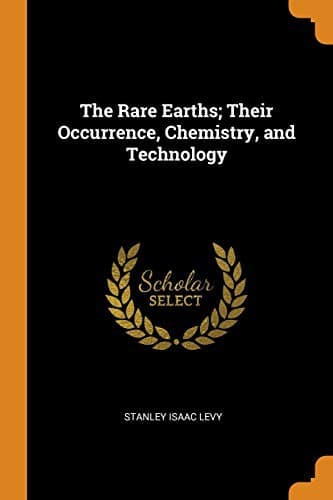
The Rare Earths: Their Occurrence, Chemistry, and TechnologyLevy, Stanley Isaac
Science
The Rare Earths: Their Occurrence, Chemistry, and Technology
Levy, Stanley Isaac
Rare earths
The elements of Group IVA are distinguished from the rare earth elements
by their much less strongly marked electropositive character. This is
apparent not only in the amphoteric nature of the oxides, and in the
ease with which the salts are hydrolysed in solution, but in the more
pronounced tendency to the formation of complex salts. The complex
fluorides of the type K₂RF₆ are peculiarly characteristic, and in the
case of titanium and zirconium have been very important for purposes of
analysis and atomic weight determination. The solubility of zirconium
and thorium salts in excess of alkali oxalate or carbonate is also in
harmony with the less pronounced electropositive character of these
elements. The sulphates of titanium and zirconium appear to be of
complex constitution, whilst their neutral chlorides cannot be obtained
from solution. As is to be expected from its high atomic weight, thorium
approaches most nearly to the rare earths in chemical properties; thus
it forms stable double nitrates of the type R₂Th(NO₃)₆ and its salts,
especially the sulphate, resemble those of the rare earth elements in
their solubility relations.
The elements titanium, zirconium, and thorium are distinguished also by
the fact that they form no definite hydroxides. The precipitates thrown
down from solutions of the salts, on addition of alkali, are hydrated
oxides, which lose water continuously when dried, giving rise to no
definite chemical individuals until constant weight is reached with the
anhydrous oxides. The hydroxides have the further characteristic, common
also to the other members of Group IV, of readily forming colloidal
solutions and gels, a property possessed to some extent also by the
elements themselves, and particularly by zirconium, which, when reduced
from its compounds, shows a great tendency to go into colloidal solution
merely on washing. Highly characteristic also is the property of forming
‘meta’-oxides (acids) and ‘meta’-salts, which is common to all the Group
IV elements which have solid oxides.
In presence of hydrogen peroxide, alkalies throw down characteristic
hydrated peroxides, which have definite acidic properties in the case of
titanium: the zirconium compound is less strongly acidic, the cerium
compound shows no tendency to salt formation, whilst if hydrogen
peroxide be added to a neutral or faintly acid solution of a thorium
salt, the precipitate is a peroxy-salt, containing some acid grouping,
_e.g._ SO₄,NO₃.
Public-domain text, read in full here on John Shaqi.
Reviews
Reviews
No reviews yet
Be the first to share your thoughts on this work.
Elsewhere in the archive
Join the Discussion
Join the discussion
Sign in to leave a comment or review.
Sign InorCreate an account