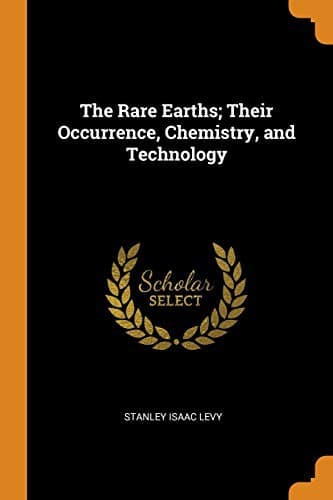
The Rare Earths: Their Occurrence, Chemistry, and TechnologyLevy, Stanley Isaac
Science
The Rare Earths: Their Occurrence, Chemistry, and Technology
Levy, Stanley Isaac
Rare earths
Berzelius prepared an impure titanium (Ti = 86 per cent.) by reduction
of potassium titanofluoride with potassium; the method was modified by
Wöhler, who heated a tube containing two boats, of which one was filled
with the fluoride, the other with sodium, reduction being effected by
the sodium vapour. Many authors have attempted the reduction of titanium
tetrachloride by means of hydrogen. By heating the tetrachloride with
sodium in a cast iron bomb, Nilson and Pettersson obtained a product
containing 95 per cent. of the element. Reduction of the dioxide by
means of sodium, magnesium, silicon, or aluminium has not been found to
yield good results, by reason of the ease with which titanium alloys
with these elements. Reduction of the dioxide with carbon yields good
results only when precautions are taken to avoid the formation of the
compound which the element so readily forms with carbon and nitrogen.
Moissan[438] found that if temperatures high enough to decompose this
compound were used, the product contained as the only impurity carbon,
which could be partly removed by fusing with the dioxide; the product
then contained 98 per cent. of titanium.
[438] _Compt. rend._ 1895, ~120~, 290.
The element has been obtained in the fused condition by Weiss and
Kayser,[439] who pressed the amorphous form into sticks, under a
pressure of 70,000 atmospheres, and employed these as pencils for the
electric arc _in vacuo_; the metal fused, forming globules on the ends
of the electrodes, which were detached after the apparatus had been
allowed to cool.
[439] _Zeitsch. anorg. Chem._ 1910, ~65~, 388.
The amorphous element is a dark powder, resembling finely divided iron
(Ferrum reductum), of density 3·5-3·6. The specific heat rises rapidly
with the temperature, so that the atomic heat has the values 5·40
between 0° and 100°, 6·18 between 0° and 210°, 7·13 between 0° and 300°,
and 7·77 between 0° and 440°. The amorphous element is said to be
paramagnetic.
The fused carbonaceous product of Moissan formed an extremely brittle
mass, with a shining white lustre on the fractured surface, sufficiently
hard to scratch quartz and steel; its density was determined as 4·87.
The product of Weiss and Kayser was also extremely hard and brittle;
when rubbed against steel, it gave bright sparks. Its density was found
to be 5·174, and the heat of combustion for the gram-atom, 97·79 K.
Public-domain text, read in full here on John Shaqi.
Reviews
Reviews
No reviews yet
Be the first to share your thoughts on this work.
Elsewhere in the archive
Join the Discussion
Join the discussion
Sign in to leave a comment or review.
Sign InorCreate an account