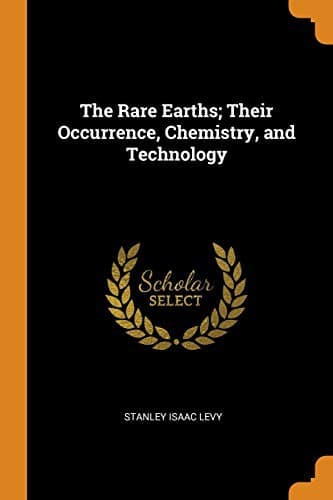
The Rare Earths: Their Occurrence, Chemistry, and TechnologyLevy, Stanley Isaac
Science
The Rare Earths: Their Occurrence, Chemistry, and Technology
Levy, Stanley Isaac
Rare earths
The _estimation_ of zirconium is complicated by the difficulty of
separating it from the accompanying elements. The solubility of the
oxalate in oxalic acid allows of a rapid and easy separation from
thorium and rare earth elements, so that iron, aluminium, and chromium
only remain to be removed. Iron may be separated by the thiosulphate
method, or other processes mentioned on p. 338; when free from that
element, zirconium may be separated from aluminium and chromium by
precipitation with alkali iodate in presence of the least possible
excess of acid. The precipitates in the thiosulphate and iodate methods
may be washed, and ignited directly to the dioxide, which is weighed as
such; if the zirconium is left after separation in solution, it may be
precipitated with ammonia,[473] and after washing and drying, ignited
and weighed as dioxide.
[473] On account of the adsorption of alkalies by the zirconium oxide
gel, potash or soda is never used for this precipitation.
~Thorium~, Th = 232·4
The name Thoria (thorina) was proposed by Berzelius in 1817 for what
appeared to be a new earth, but which in 1824 was recognised as a basic
yttria phosphate. In 1828 a new mineral was discovered by Esmark near
Brevig in Norway; to the oxide isolated from this, Berzelius gave the
name thoria, from its resemblance to the substance he had obtained in
1817. The homogeneity of the new element was questioned by Bergmann in
1857, and also by Bahr in 1862, but the conclusions of those authors
have been shown to be quite unfounded.
Thorium occurs in traces in a large number of common minerals, and in
varying quantities in most of the uranium and rare earth minerals. Its
occurrence in monazite, and the distribution of the latter mineral, have
already been dealt with; the commercial treatment of monazite is
described in Chapter XVIII. The oxide forms the chief constituent in
Thorite, with its gem-variety Orangite, and the various secondary
minerals, and in the mineral Thorianite, in which the only other
important constituent is uranous oxide. The extraction from these
minerals is a comparatively simple matter. Decomposition is easily
effected by hydrochloric or sulphuric acid, thorianite dissolving easily
also in nitric acid; the solutions obtained, after appropriate treatment
to remove silica, excess of acid, etc., are treated with sulphuretted
hydrogen, to remove lead, bismuth, and similar foreign metals, and freed
from the rare earths by the carbonate, oxalate, or sulphate methods. The
last depends on the fact that thorium sulphate and its hydrates are much
less soluble than corresponding compounds of the rare earth elements;
the first two on the fact that thorium salts dissolve readily in excess
of alkali carbonates or oxalates, whilst the rare earth compounds are
much less easily soluble.
Public-domain text, read in full here on John Shaqi.
Reviews
Reviews
No reviews yet
Be the first to share your thoughts on this work.
Elsewhere in the archive
Join the Discussion
Join the discussion
Sign in to leave a comment or review.
Sign InorCreate an account