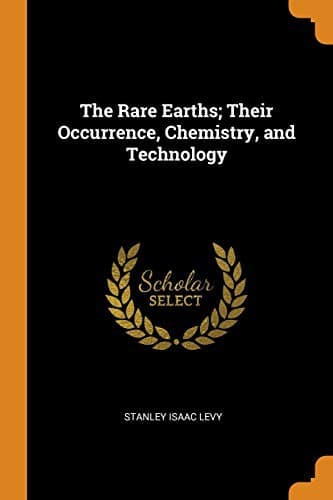
The Rare Earths: Their Occurrence, Chemistry, and TechnologyLevy, Stanley Isaac
Science
The Rare Earths: Their Occurrence, Chemistry, and Technology
Levy, Stanley Isaac
Rare earths
~Chromates.~--The rare earth chromates are, as a rule, sparingly soluble
in water, and show considerable differences of solubility amongst
themselves; for this reason, they have been of some use in the
separation of the cerium elements.[165] They are obtained by addition of
potassium chromate to neutral solutions of rare earth salts as
crystalline precipitates, of the general formula R₂(CrO₄)₃,8H₂O; with a
large excess of alkali chromate, double chromates are obtained, which
are more readily formed, and more soluble, in the yttrium series than in
the cerium group. Addition of chromic acid or alkali bichromate to
solutions of the soluble salts gives no precipitate, a fact which allows
of the separation of zirconium and thorium, and of cerium in the
tetravalent state, since the tetravalent elements are precipitated by
both these reagents.
[165] Muthmann and Böhm, _Ber._ 1900, ~33~, 42; Böhm, _Zeitsch. angew.
Chem._ 1904, ~15~, 372 and 1282.
Ammonium molybdate throws down from neutral solution of rare earth salts
gelatinous precipitates of the _molybdates_; the formula La₂2(HMoO₄)₆ is
assigned to the lanthanum compound obtained in this way. No
precipitation occurs if the solution be strongly acid; on this fact a
process has recently been based for the volumetric estimation of
thorium, in presence of rare earth salts, by means of ammonium molybdate
(see p. 289).
Various _silicotungstates_ and _double tungstates_ have been described.
~Carbonates.~--The more pronounced electropositive character of the rare
earth elements, as contrasted with other trivalent metals, is well
illustrated by the fact that they form stable neutral carbonates of the
formula R₂(CO₃)₃,_x_H₂O. These may be obtained by passing a current of
carbon dioxide through an aqueous suspension of the hydroxides, or by
addition of an alkali carbonate to neutral solutions of the salts. Basic
carbonates are known in the case of the less positive yttrium elements
only; both these and the neutral carbonates are insoluble in water.
Public-domain text, read in full here on John Shaqi.
Reviews
Reviews
No reviews yet
Be the first to share your thoughts on this work.
Elsewhere in the archive
Join the Discussion
Join the discussion
Sign in to leave a comment or review.
Sign InorCreate an account