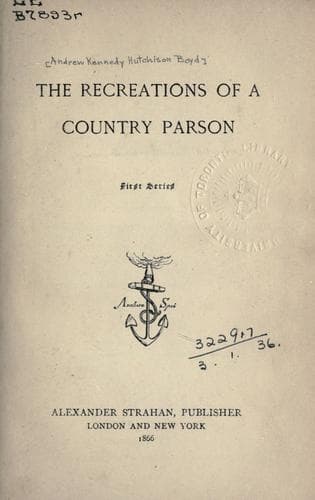
The Recreations of a Country ParsonBoyd, Andrew Kennedy Hutchison
General
The Recreations of a Country Parson
Boyd, Andrew Kennedy Hutchison
Clergy -- Anecdotes; Country life -- England; Rural clergy -- England
But in no way of regarding the case can any excuse be found for
persons who steal and stick into their discourses tawdry little bits
of bombast, purple patches of thought or sentiment, which cannot
be supposed to do any good to anybody, which stand merely instead
of a little stolen gilding for the gingerbread which is probably
stolen too. I happened the other day to turn over a volume of
discourses (not, I am thankful to say, by a clergyman of either
of the national churches), and I came upon a sermon or lecture on
Woman. You can imagine the kind of thing it was. It was by no means
devoid of talent. The writer is plainly a clever, flippant person,
with little sense, and no taste at all. The discourse sets out
with a request that the audience 'would kindly try to keep awake by
pinching one another in the leg, or giving some nodding neighbour
a friendly pull of the hair;' and then there is a good deal about
Woman, in the style of a Yankee after-dinner speech in proposing such
a toast. After a little we have a highly romantic description of
a battle-field after the battle, in which gasping steeds, midnight
ravens, spectral bats, moping owls, screeching vultures, howling
night wolves appear. These animals are suddenly startled by a figure
going about with a lantern 'to find the one she loves.' Of course
the figure is a woman; and the paragraph winds up with the following
passage:--
Shall we go to her? No! Let her weep on. Leave her, &c. Oh, woman!
God beloved in old Jerusalem! We need deal lightly with thy faults,
if only for the agony thy nature will endure, in bearing heavy
evidence against us on the day of judgment!
Now, my friend, have you read Mr. Dickens' story of Martin Chuzzlewit?
Turn up the twenty-eighth chapter of that work, and in the closing
sentence you may read as follows:--
Oh woman, God-beloved in old Jerusalem! The best among us need deal
lightly with thy faults, if only for the punishment thy nature will
endure, in bearing heavy evidence against us on the Day of Judgment!
I wonder whether the writer of the discourse imagined that by varying
one or two words, and adopting small letters instead of capitals
in alluding to the Last Day, he made this sentence so entirely his
own as to justify him in bagging it without one hint that it was a
quotation. As for the value of the property bagged, that is another
question.
Public-domain text, read in full here on John Shaqi.
Reviews
Reviews
No reviews yet
Be the first to share your thoughts on this work.
Elsewhere in the archive
Join the Discussion
Join the discussion
Sign in to leave a comment or review.
Sign InorCreate an account