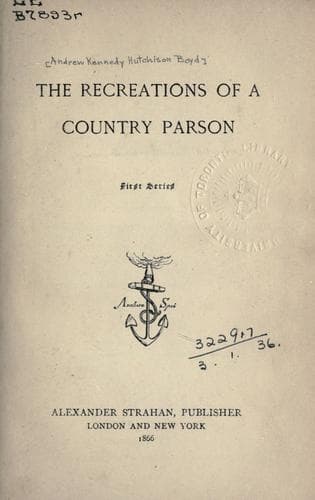
The Recreations of a Country ParsonBoyd, Andrew Kennedy Hutchison
General
The Recreations of a Country Parson
Boyd, Andrew Kennedy Hutchison
Clergy -- Anecdotes; Country life -- England; Rural clergy -- England
And, happily, that which we do not know does us no harm: at least,
gives us no pain. And it is a law, a kindly and a reasonable law,
of civilized life, that when it is not absolutely necessary that
a man should know that which would give him pain, he shall not be
told of it. Only the most malicious violate this law. Even they
cannot do it long: for they come to be excluded from society as
its common enemies. One great characteristic of educated society
is this: it is always under a certain degree of Restraint. Nohody,
in public, speaks out all his mind. Nobody tells the whole truth,
at least, in public speeches and writings. It is a terrible thing
when an inexperienced man in Parliament (for instance) blurts out
the awkward fact which everybody knows, but of which nobody is to
speak except in the confidence of friendship or private society.
How such a man is hounded down! He is every one's enemy. Every one
is afraid of him. No one knows what he may say next. And it is quite
fit that he should be stopped. Civilized life could not otherwise
go on. It is quite right (when you calmly reflect upon it) that the
county paper, speaking of the member of Parliament, should tell us
how this much-respected gentleman has been visiting his Constituents,
but should suppress a good deal of the speech he made, which the
editor (though of the same politics) tells you frankly was worthy
only of an escaped lunatic. Above all, it is fit and decent that
the very odd private life and character of the legislator should be
by tacit consent ignored even by the journals most opposed to him.
It is right that kings and nobles should be, for the most part,
spoken of in public as if they actually were what they ought to be.
It is something of a reminder and a rebuke to them: and it is just
as well that mankind at large should not know too much of the actual
fact as to those above them. I should never object to calling a
graceless duke Tour Grace: nor to praying for a villariously bad
monarch as our most religious and gracious King (I know quite well,
small critic, that religious is an absurd mistranslation: but let
us take the liturgy in the sense in which ninety-nine out of every
hundred who hear it understand it): for it seems to me that the
daily recurring phrases are something ever suggesting what mankind
have a right to expect from those in eminent station; and a kindly
determination to believe that such are at least endeavoring to be
what they ought. No doubt there is often most bitter rehuke in the
names! This law of Restraint extends to all the doings of civilized
men. No one does anything to the very utmost of his ability. No
one speaks the entire truth, unless in confidence. No one exerts
his whole bodily strength. No one ever spoke at the very top of
his voice, unless in mortal extremity. Unquestionably, the feeling
that you must work within limits curtails the result accomplished.
You may see this in cases in which the restraint of the civilized
Public-domain text, read in full here on John Shaqi.
Reviews
Reviews
No reviews yet
Be the first to share your thoughts on this work.
Elsewhere in the archive
Join the Discussion
Join the discussion
Sign in to leave a comment or review.
Sign InorCreate an account