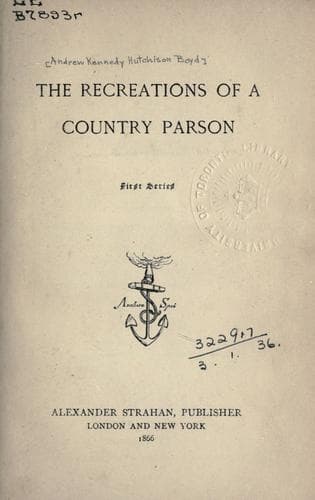
The Recreations of a Country ParsonBoyd, Andrew Kennedy Hutchison
General
The Recreations of a Country Parson
Boyd, Andrew Kennedy Hutchison
Clergy -- Anecdotes; Country life -- England; Rural clergy -- England
his mind was breaking down: he has himself recorded that he often
thought of casting off, by suicide, the unendurable burden of life.
And Still, what work the rickety machine got through! With tearing
headaches, with a sunken chest, with the least muscular of limbs,
with the most melancholy of temperaments, worried and tormented by
piracies of his great inventions, yet doing so much and doing it
so nobly, was not James Watt like the lame race-horse that won the
Derby? As for Byron, he was unquestionably a very great man; and
as a poet, he is in his own school without a rival. Still, he was
a screw. There was something morbid and unsound about his entire
development. In many respects he was extremely silly. It was
extremely silly to take pains to represent that he was morally
much worse than he really was. The greatest blockheads I know are
distinguished by the same characteristic. Oh, empty-headed Noodle!
who have more than once dropped hints in my presence as to the awful
badness of your life, and the unhappy insight which your life has
given you into the moral rottenness of society, don't do it again.
I always thought you a contemptible fool: but next time I mean to
tell you so. Wordsworth was a screw. Though one of the greatest of
poets, he was dreadfully twisted by inordinate egotism and vanity:
the result partly of original constitution, and partly of living
a great deal too much alone in that damp and misty lake country.
lie was like a spavined horse. Coleridge, again, was a jibber. He
never would pull in the team of life. There is something unsound
in the mind of the man who fancies that because he is a genius,
he need not support his wife and children. Even the sensible and
exemplary Southey was a little unsound in the matter of a crotchety
temper, needlessly ready to take offence. He was always quarrelling
with his associates in the Quarterly Review: with the editor and
the publisher. Perhaps you remember how on one occasion he wrought
himself up into a fever of wrath with Mr. Murray, because that
gentleman suggested a subject on which he wished Southey to write
for the Quarterly, and begged him to put his whole strength to it,
the subject being one which was just then of great interest and
importance. 'Flagrant insolence,' exclaimed Southey. 'Think of
the fellow bidding me put my whole strength to an article in his
six-shilling Review!' Now, reader, there you see the evil consequence
of a man who is a little of a screw in point of temper, living in
the country. Most reasonable men would never have discerned any
insult in Mr. Murray's request: but even if such a one had thought
it a shade too authoritatively expressed, he would, if he had lived
in town, gone out to the crowded street, gone down to his club,
and in half an hour have entirely forgotten the little disagreeable
impression. But a touchy man, dwelling in the country, gets the
irritative letter by the morning's post, is worried by it all the
Public-domain text, read in full here on John Shaqi.
Reviews
Reviews
No reviews yet
Be the first to share your thoughts on this work.
Elsewhere in the archive
Join the Discussion
Join the discussion
Sign in to leave a comment or review.
Sign InorCreate an account