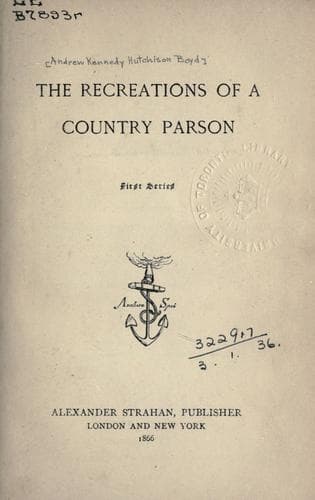
The Recreations of a Country ParsonBoyd, Andrew Kennedy Hutchison
General
The Recreations of a Country Parson
Boyd, Andrew Kennedy Hutchison
Clergy -- Anecdotes; Country life -- England; Rural clergy -- England
In the case of commonplace screws, if they do their work well, it
is for the most part in spite of their being screws. It is because
they are sound in the main, in those portions of their mental
constitution which their daily work calls into play; and because
they are seldom required to do those things which their unsoundness
makes them unfit to do. You know, if a horse never fell lame except
when smartly trotted down a hill four miles long, you might say that
for practical purposes that horse was never lame at all. For the
single contingency to which its powers are unequal would hardly ever
occur. In like manner, if the mind of a tradesman is quite equal
to the management of his business and the respectable training of
his family, you may say that the tradesman's mind is for practical
purposes a sound and good one; although if called to consider some
important political question, such as that of the connexion of
Church and State, his judgment might be purely idiotical. You see,
he is hardly ever required to put his mind (so to speak) at a hill
at which it would break down. I have walked a mile along the road
with a respectable Scotch farmer, talking of country matters; and
I have concluded that I had hardly ever conversed with a shrewder
and more sensible man. But having accidentally chanced to speak of
a certain complicated political question, I found that quoad hoc
my friend's intellect was that of a baby. I had just come upon the
four-mile descent which would knock up the horse which for ordinary
work was sound.
Yes, reader, in the case of commonplace screws, if hey do their
work well, it is in spite of their being screws. But in the case of
great geniuses who are screws, it is often because of their unsoundness
that they do the fine things they do. It is the hectic beauty which
his morbid mind cast upon his page, that made Byron the attractive
and fascinating poet that he is to young and inexperienced minds.
Had his views been sounder and his feeling healthier, he might
have been but a commonplace writer after all. In poetry, and in
all imaginative writing, we look for beauty, not for sense; and we
all know that what is properly disease and unsoundness sometimes
adds to beauty. You know the delicate flush, the bright eyes, the
long eyelashes, which we often see in a young girl on whom consumption
is doing its work. You know the peachy complexion which often goes
with undeveloped scrofula. And had Charles Lamb not been trembling
on the verge of insanity, the Essays of Elia would have wanted great
part of their strange, undefinable charm. Had Ford and Massinger led
more regular lives and written more reasonable sentiments, what a
caput mortuum their tragedies would be! Had Coleridge been a man
of homely common-sense, he would never have written Christabel. I
remember in my boyhood reading The Ancient Mariner to a hard-headed
lawyer of no literary taste. He listened to the poem, and merely
remarked that its author was a horrible fool.
Public-domain text, read in full here on John Shaqi.
Reviews
Reviews
No reviews yet
Be the first to share your thoughts on this work.
Elsewhere in the archive
Join the Discussion
Join the discussion
Sign in to leave a comment or review.
Sign InorCreate an account