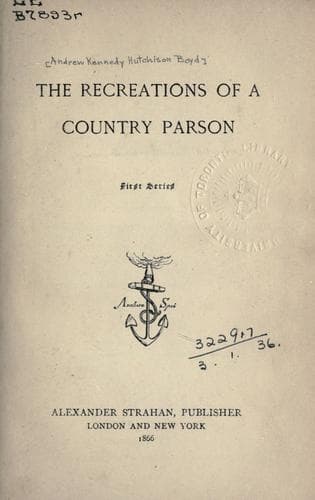
The Recreations of a Country ParsonBoyd, Andrew Kennedy Hutchison
General
The Recreations of a Country Parson
Boyd, Andrew Kennedy Hutchison
Clergy -- Anecdotes; Country life -- England; Rural clergy -- England
A very subdued mood of thought and feeling, I think, creeps gradually
over a man living such a solitary life. I mean a man who has been
accustomed to a house with many inmates. There is something odd in
the look of an apartment in which hardly a word is ever spoken. If
you speak while by yourself, it is in a very low tone; and though
you may smile, I don't think any sane man could often laugh heartily
while by himself. Think of a life in which, while at home, there
is no talking and no laughing. Why, one distinctive characteristic
of rational man is cut off when laughing ceases. Man is the only
living creature that laughs with the sense of enjoyment. I have
heard, indeed, of the laughing hyena; but my information respecting it
is mainly drawn from Shakspeare, who was rather a great philosopher
and poet than a great naturalist. 'I will laugh like a hyen,'
says that great man; and as these words are spoken as a threat,
I apprehend the laughter in question is of an unpleasant and
umnirthful character. But to return from such deep thoughts, let
it be repeated, that the entire mood of the solitary man is likely
to be a sobered and subdued one. Even if hopeful and content, he
will never be in high spirits. The highest degree in the scale he
will ever reach, may be that of quiet lightheartedness; and that
will come seldom. Jollity, or exhilaration, is entirely a social
thing. I do not believe that even Sydney Smith could have got into
one of his rollicking veins when alone. He enjoyed his own jokes,
and laughed at them with extraordinary zest; but he enjoyed them
because he thought others were enjoying them too. Why, you would
be terrified that your friend's mind was going, if before entering
his room you heard such a peal of merriment from within, as would
seem a most natural thing were two or three cheerful companions
together. And gradually that chastened, subdued stage comes, in
which a man can sit for half an hour before the fire as motionless
as marble; even a man who in the society of others is in ceaseless
movement. It is an odd feeling, when you find that you yourself,
once the most restless of living creatures, have come to this. I
dare say Robinson Crusoe often sat for two or three hours together
in his cave, without stirring hand or foot. The vital principle
grows weak when isolated. You must have a number of embers together
to make a warm fire; separate them, and they will soon go out and
grow cold. And even so, to have brisk, conscious, vigorous life,
you must have a number of lives together. They keep each other warm.
They encourage and support each other. I dare say the solitary man,
sitting at the close of a long evening by his lonely fireside, has
sometimes felt as though the flame of life had sunk so low that a
very little thing would be enough to put it out altogether. From
the motionless limbs, from the unstrung hands, it seemed as though
vitality had ebbed away, and barely kept its home in the feeble
heart.
Public-domain text, read in full here on John Shaqi.
Reviews
Reviews
No reviews yet
Be the first to share your thoughts on this work.
Elsewhere in the archive
Join the Discussion
Join the discussion
Sign in to leave a comment or review.
Sign InorCreate an account