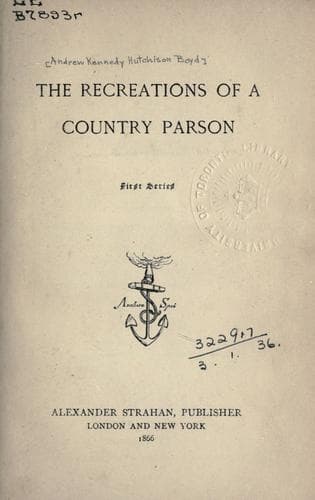
The Recreations of a Country ParsonBoyd, Andrew Kennedy Hutchison
General
The Recreations of a Country Parson
Boyd, Andrew Kennedy Hutchison
Clergy -- Anecdotes; Country life -- England; Rural clergy -- England
The influence of nature on most minds is likely to be a healthful
one; still, it is not desirable to allow that influence to become
too strong. And there is a further influence which is felt in a
solitary life, which ought never to be permitted to gain the upper
hand. I mean the influence of our own mental moods. It is not
expedient to lead too subjective a life. We look at all things,
doubtless, through our own atmosphere; our eyes, to a great extent,
make the world they see. And no doubt, too, it is the sunshine
within the breast that has most power to brighten; and the thing
that can do most to darken is the shadow there. Still, it is not
fit that these mental moods should be permitted to arise mainly
through the mind's own working. It is not fit that a man should
watch his mental moods as he marks the weather; and be always
chronicling that on such a day and such another he was in high or
low spirits, he was kindly-disposed or snappish, as the case may be.
The more stirring influence of intercourse with others, renders men
comparatively heedless of the ups and downs of their own feelings;
change of scenes and faces, conversation, business engagements,
may make the day a lively or a depressed one, though they rose at
morning with a tendency to just the opposite thing. But the solitary
man is apt to look too much inward; and to attach undue importance
to the fancies and emotions which arise spontaneously within his
own breast; many of them in great measure the result of material
causes. And as it is not a healthy thing for a man to be always
feeling his pulse, and fearing that it shows something amiss; it
is not a healthy thing to follow the analogous course as regards
our immaterial health and development. And I cannot but regard those
religious biographies which we sometimes read, in which worthy
people of little strength of character record particularly from
day to day all the shifting moods and fancies of their minds as
regards their religious concerns, as calculated to do a great deal
of mischief. It is founded upon a quite mistaken notion of the spirit
of true Christianity, that a human being should be ever watching
the play of his mind, as one might watch the rise and fall of the
barometer; and recording phases of thought and feeling which it
is easy to see are in some cases, and in some degree, at least,
the result of change of temperature, of dyspepsia, of deranged
circulation of the blood, as though these were the unquestionable
effects of spiritual influence, either supernal or infernal. Let us
try, in the matter of these most solemn of all interests, to look
more to great truths and facts which exist quite independently of
the impression they may for the time produce upon us; and less to
our own fanciful or morbid frames and feelings.
Public-domain text, read in full here on John Shaqi.
Reviews
Reviews
No reviews yet
Be the first to share your thoughts on this work.
Elsewhere in the archive
Join the Discussion
Join the discussion
Sign in to leave a comment or review.
Sign InorCreate an account