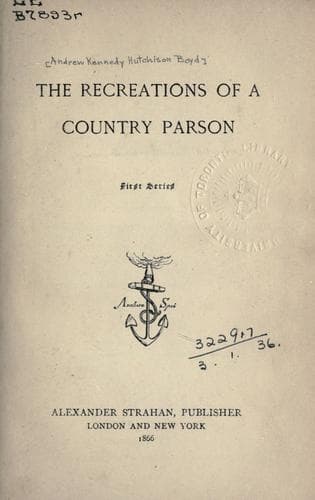
The Recreations of a Country ParsonBoyd, Andrew Kennedy Hutchison
General
The Recreations of a Country Parson
Boyd, Andrew Kennedy Hutchison
Clergy -- Anecdotes; Country life -- England; Rural clergy -- England
showing us a thoroughly Glasgow feature; for nowhere in Britain,
we should fancy, is there so much talk about preaching and preachers.
In sailing down the Frith, one gets no just idea of the richness
and beauty of its shores. We have said that a little strip of fine
soil,--in some places only fifty or sixty yards in breadth,--runs
like a ribbon, occasionally broadening out to three or four times
that extent, along the sea-margin; beyond this ribbon of ground come
the wild moor and mountain. In sailing down the Frith, our eye is
caught by the large expanse of moorland, and we do not give due
importance to the rich strip which bounds it, like an edging of
gold lace (to use King James's comparison) round a russet petticoat.
When we land we understand things better. We find next the sea,
at almost any point along the Frith, the turnpike road, generally
nearly level, and beautifully smooth. Here and there, in the
places of older date, we find quite a street of contiguous houses;
but the general rule is of detached dwellings of all grades, from
the humblest cottage to the most luxurious villa. At considerable
intervals, there are residences of a much higher class than even
this last, whose grounds stretch for long distances along the shore.
Such places are Ardgovvan, Kelly, Skelmorlie Castle, and Kelburne,
on the Ayrshire side; and on the other shore of the Frith, Roseneath
Castle, Toward Castle, and Mountstuart. [Footnote: Ardgowan, residence
of Sir Michael Shaw Stewart; Kelly, Mr. Scott; Skelmorlie, the Earl
of Eglinton; Kelburne, the Earl of Glasgow; Roseneath, the Duke of
Argyle; Toward, Mr. Kirkwall Finlay Mountstuart, the Marquis of
Bute.] And of dwellings of a less ambitious standing than these
really grand abodes, yet of a mark much above that suggested by
the word villa, we may name the very showy house of Mr. Napier, the
eminent maker of marine steam-engines, on the Gareloch, a building
in the Saracenic style, which cost we are afraid to say how many
thousand pounds; the finely-placed castle of Wemyss, built from
the design of Billings; and the very striking piece of baronial
architecture called Knock Castle, the residence of Mr. Steel, a
wealthy shipbuilder of Greenock. The houses along the Frith are,
in Scotch fashion, built exclusively of stone, which is obtained
with great facility. Along the Ayrshire coast, the warm-looking
red sandstone of the district is to be had everywhere, almost on
the surface. One sometimes sees a house rising, the stone being
taken from a deep quarry close to it: the same crane often serving
to lift a block from the quarry, and to place it in its permanent
position upon the advancing wall. We have said how rich is vegetation
all along the Frith, until we reach the sandy downs from Ardrossan
to Ayr. All evergreens grow with great rapidity: ivy covers dead
walls very soon. To understand in what luxuriance vegetable life
may be maintained close to the sea-margin, one must walk along the
Public-domain text, read in full here on John Shaqi.
Reviews
Reviews
No reviews yet
Be the first to share your thoughts on this work.
Elsewhere in the archive
Join the Discussion
Join the discussion
Sign in to leave a comment or review.
Sign InorCreate an account