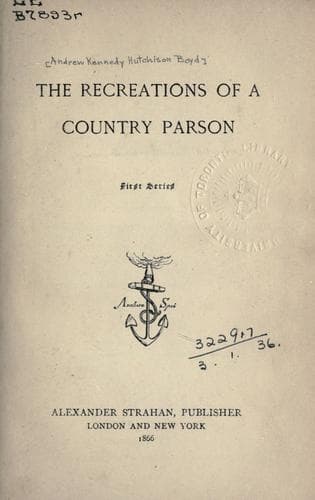
The Recreations of a Country ParsonBoyd, Andrew Kennedy Hutchison
General
The Recreations of a Country Parson
Boyd, Andrew Kennedy Hutchison
Clergy -- Anecdotes; Country life -- England; Rural clergy -- England
There are several statements made by Mr. Buckle which must not be
regarded as setting forth the teaching of the Magazine in which
they were made. Mr. Buckle says that no man can be sure that any
doctrine is divinely revealed: that whoever says so must be 'absurdly
and immodestly confident in his own powers.' I deny that. Mr. Buckle
says that it is part of Christian doctrine that rich men cannot be
saved. I deny that. Christ's statement as to the power of worldly
possessions to concentrate the affections upon this world, went
not an inch further than daily experience goes. What said Samuel
Johnson when Garrick showed him his grand house? 'Ah, David, these
are the things that make death terrible!' Mr. Buckle says that
Christianity gained ground in early ages because its doctrines were
combated. They were not combated. Its professors were persecuted,
which is quite another thing. Mr. Buckle says that the doctrine of
Immortality was known to the world before Christianity was heard
of, or any other revealed religion. I deny that. Greek and Roman
philosophers of the highest class regarded that doctrine as a delusion
of the vulgar. Did Mr. Buckle ever read the letter of condolence
which Sulpicius wrote to Cicero after the death of Cicero's daughter?
A beautiful letter, beautifully expressed; stating many flimsy and
wretched reasons for drying one's tears; but containing not a hint
of any hope of meeting in another world. And the same may be said
of Cicero's reply. As for Mr. Buckle's argument for Immortality,
I think it extremely weak and inconclusive. It certainly goes to
prove, if it proves anything, that my cousin Tom, who lately was
called to the bar, is quite sure to be Lord Chancellor; and that
Sam Lloyd, who went up from our village last week to a merchant's
counting-house in Liverpool, is safe to rival his eminent namesake
in wealth. Mr. Buckle's argument is just this: that if your heart
is very much set upon a thing, you are perfectly sure to get it.
Of course everybody has read the soliloquy in Addison's Cato, where
Mr. Buckle's argument is set forth. I deem it not worth a rush.
Does any man's experience of this life tend to assure him, that
because some people (and not all people) would like to see their
friends again after they die, therefore they shall? Do things
usually turn out just as we particularly wish that they should turn
out? Has not many a young girl felt, like Cato, a 'secret dread
and inward horror' lest the pic-nic day should be rainy? Did that
ensure its being fine? Was not I extremely anxious to catch the
express train yesterday, and did not I miss it? Does not every
child of ten years old know, that this is a world in which things
have a wonderful knack of falling out just in the way least wished
for? If I were an infidel, I should believe that some spiteful imp
of the perverse had the guidance of the affairs of humanity. I know
better than that: but for my knowledge I have to thank Revelation.
Public-domain text, read in full here on John Shaqi.
Reviews
Reviews
No reviews yet
Be the first to share your thoughts on this work.
Elsewhere in the archive
Join the Discussion
Join the discussion
Sign in to leave a comment or review.
Sign InorCreate an account