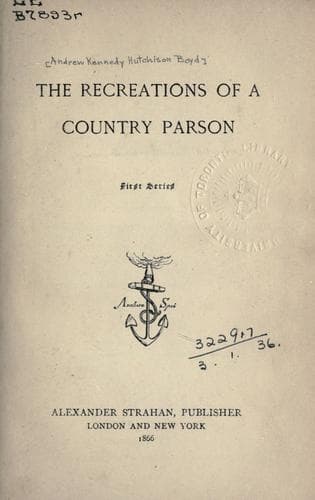
The Recreations of a Country ParsonBoyd, Andrew Kennedy Hutchison
General
The Recreations of a Country Parson
Boyd, Andrew Kennedy Hutchison
Clergy -- Anecdotes; Country life -- England; Rural clergy -- England
Mr. Lane seems to have been in a very bad way. He gives an appalling
account of the medical treatment under which he had suffered for
nearly thirty years. In spite of it all he found, at the age of
forty-five, that his entire system was showing signs of breaking up.
He was suffering from neuralgia, which we believe means something
like tic-douloureux extending over the whole body; he was threatened
with paralysis, which had advanced so far as to have benumbed his
right side; his memory was going; his mind was weakened; he was,
in his own words, 'no use to anybody:' there were deep cracks
round the edge of his tongue; his throat was ulcerated; in short,
he was in a shocking state, and never likely to be better. Like many
people in such sad circumstances, lie had tried all other remedies
before thinking of the Water Cure; he had resorted to galvanism,
and so forth, but always got worse. At length, on the 13th of May,
1845, Mr. Lane betook himself to Malvern, where Dr. Wilson presides
over one of the largest cold-water establishments in the kingdom.
In those days there were some seventy patients in residence, but
the new-comer was pleased to find that there was nothing repulsive
in the appearance of any of his confreres,--a consideration
of material importance, inasmuch as the patients breakfast, dine,
and sup together. Nothing could have a more depressing effect upon
any invalid, than to be constantly surrounded by a crowd of people
manifestly dying, or afflicted with visible and disagreeable disease.
The fact is, judging from our own experience, that the people who
go to the Water Cure are for the most part not suffering from real
and tangible ailments, but from maladies of a comparatively fanciful
kind,--such as low spirits, shattered nerves, and lassitude, the
result of overwork. And our readers may be disposed to think, with
ourselves, that the change of air and scene, the return to a simple
and natural mode of life, and the breaking off from the cares
and engagements of business, have quite as much to do with their
restoration as the water-system, properly so called.
The situation of Malvern is well adapted to the successful use of
the water system. Sir E. B. Lytton tells us that 'the air of Malvern
is in itself hygeian: the water is immemorially celebrated for its
purity: the landscape is a perpetual pleasure to the eye.' The
neighbouring hills offer the exercise most suited to the cure:
Priessnitz said 'One must have mountains:' and Dr. Wilson told Mr.
Lane, in answer to a remark that the Water Cure had failed at Bath
and Cheltenham, that 'no good and difficult cures can be made in low
or damp situations, by swampy grounds, or near the beds of rivers.'
Public-domain text, read in full here on John Shaqi.
Reviews
Reviews
No reviews yet
Be the first to share your thoughts on this work.
Elsewhere in the archive
Join the Discussion
Join the discussion
Sign in to leave a comment or review.
Sign InorCreate an account