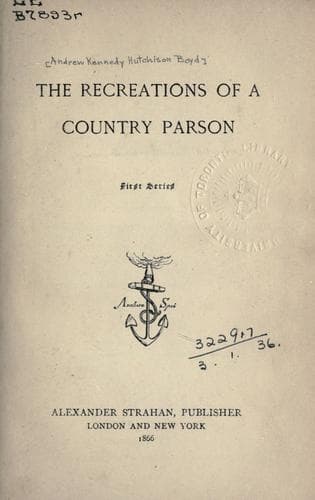
The Recreations of a Country ParsonBoyd, Andrew Kennedy Hutchison
General
The Recreations of a Country Parson
Boyd, Andrew Kennedy Hutchison
Clergy -- Anecdotes; Country life -- England; Rural clergy -- England
occasionally find so many things going wrong at once, and so many
little things demanding to be attended to at once, that he shall
experience worry in as high a degree as it can be felt by mortal.
Thus truthfully does Milverton's essay begin:--
The great characteristic of modern life is Worry.
If the Pagan religion still prevailed, the new goddess, in whose
honour temples would be raised and to whom statues would be erected in
all the capitals of the world, would he the goddess Worry. London
would be the chief seat and centre of her sway. A gorgeous statue,
painted and enriched after the manner of the ancients (for there
is no doubt that they adopted this practice, however barbarous it
may seem to us), would he set up to the goddess in the West-end of
the town: another at Temple Bar, of less ample dimensions and less
elaborate decoration, would receive the devout homage of worshippers
who came to attend their lawyers in that quarter of the town: while
a statue, on which the cunning sculptor should have impressed the
marks of haste, anxiety, and agitation, would be sharply glanced
up at, with as much veneration as they could afford to give to it,
by the eager men of business in the City.
The goddess Worry, however, would be no local deity, worshipped
merely in some great town, like Diana of the Ephesians; but, in the
market-places of small rural communities, her statue, made somewhat
like a vane, and shitting with every turn of the wind, would be
regarded with stolid awe by anxious votaries belonging to what is
called the farming interest. Familiar too and household would be
her worship: and in many a snug home, where she might be imagined
to have little potency, small and ugly images of her would be found
as household gods--the Lares and Penates--near to the threshold,
and ensconced above the glowing hearth.
The poet, always somewhat inclined to fable, speaks of Love as
ruling
The court, the camp, the grove,
And men below, and heaven above;
but the dominion of Love, as compared with that of Worry, would
be found, in the number of subjects, as the Macedonian to the
Persian--in extent of territory, as the county of Rutland to the
empire of Russia.
Not verbally accurate is the quotation from the Lay of the Last
Minstrel, we may remark; but we may take it for granted that no
reader who has exceeded the age of twenty-five will fail to recognize
in this half-playful and half-earnest passage the statement of a
sorrowful fact. And the essay goes on to set forth many of the causes
of modern worry with all the knowledge and earnestness of a man
who has seen much of life, and thought much upon what he has seen.
The author's sympathies are not so much with the grand trials of
historical personages, such as Charles V., Columbus, and Napoleon,
as with the lesser trials and cares of ordinary men; and in the
following paragraph we discern at once the conviction of a clear
head and the feeling of a kind heart:--
Public-domain text, read in full here on John Shaqi.
Reviews
Reviews
No reviews yet
Be the first to share your thoughts on this work.
Elsewhere in the archive
Join the Discussion
Join the discussion
Sign in to leave a comment or review.
Sign InorCreate an account