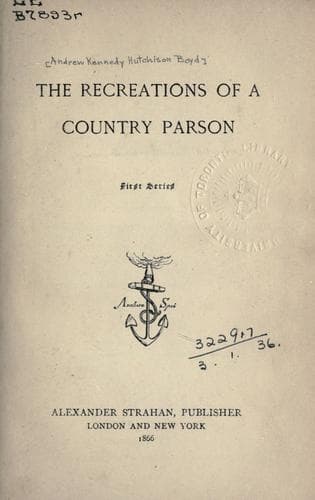
The Recreations of a Country ParsonBoyd, Andrew Kennedy Hutchison
General
The Recreations of a Country Parson
Boyd, Andrew Kennedy Hutchison
Clergy -- Anecdotes; Country life -- England; Rural clergy -- England
We have not space to inquire into the circumstances which have given
Scotch preaching its peculiar character. We may remark, however,
that the sermon is the great feature of the Scotch service; it is
the only attraction; and pains must be taken with it. The prayers
are held in very secondary estimation. The preacher who aims
at interesting his congregation, racks his brain to find what
will startle and strike; and then the warmth of his delivery adds
to his chance of keeping up attention. Then the Scotch are not a
theatre-going people; they have not, thus, those stage-associations
with a dramatic manner which would suggest themselves to many minds.
Many likewise expect that excitement in the church, which is more
suited to the atmosphere of the play-house. Patrons of late years
not unfrequently allow a congregation to choose its own minister;
the Crown almost invariably consults the people; the decided taste
of almost all songregations is for great warmth of manner; and the
supply is made to suit the demand.
As for the solemn question, how far Scotch preaching answers the
great end of all right preaching, it is hard to speak. No doubt
it is a great thing to arouse the somewhat comatose attention of
any audience to a discourse upon religion, and any means short of
clap-trap and indecorum are justified if they succeed in doing so.
No man will be informed or improved by a sermon which sets him
asleep. Yet it is to be feared that, in the prevailing rage for what
is striking and new, some eminent preachers sacrifice usefulness
to glitter. We have heard discourses concerning which, had we been
asked when they were over, What is the tendency and result of all
this?--what is the conclusion it all leads to?--we should have been
obliged to reply, Only that Mr. Such-a-one is an uncommonly clever
man. The intellectual treat, likewise, of listening to first-class
pulpit oratory, tends to draw many to church merely to enjojr it.
Many go, not to be the better for the truth set forth, but to be
delighted by the preacher's eloquence. And it is certain that many
persons whose daily life exhibits no trace of religion, have been
most regular and attentive hearers of the most striking preachers.
We may mention an instance in point. When Mr. Caird was one of the
ministers of Edinburgh, he preached in a church, one gallery of
which is allotted to students of the University. A friend of ours
was one Sunday afternoon in that gallery, when he observed in the
pew before him two very rough-looking fellows, with huge walking-sticks
projecting from their great-coat pockets, and all the unmistakable
marks of medical students. It was evident they were little accustomed
to attend any place of worship. The church, as usual, was crammed
to suffocation, and Mr. Caird preached a most stirring sermon.
As he wound up one paragraph to an overwhelming climax, the whole
congregation bent forward in eager and breathless silence. The
medical students were under the general spell.
Public-domain text, read in full here on John Shaqi.
Reviews
Reviews
No reviews yet
Be the first to share your thoughts on this work.
Elsewhere in the archive
Join the Discussion
Join the discussion
Sign in to leave a comment or review.
Sign InorCreate an account