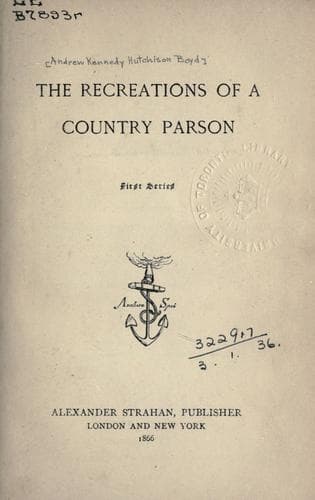
The Recreations of a Country ParsonBoyd, Andrew Kennedy Hutchison
General
The Recreations of a Country Parson
Boyd, Andrew Kennedy Hutchison
Clergy -- Anecdotes; Country life -- England; Rural clergy -- England
The burden of the discourse is to prove that this is so; that
religion is compatible with the business of Common Life. This
appears, first, because religion, as a science, sets out doctrines
easy to be understood by the humblest intellects; and as an art,
sets out duties which may be practised simultaneously with all
other work. It is the art of being and of doing good: and for this
art every profession and calling affords scope and discipline.
When a child is learning to write, it matters not of what words the
copy set to him is composed, the thing desired being that, whatever
he writes, he learns to write well. When a man is learning to be
a Christian, it matters not what his particular work in life may
be, the work he does is but the copy-line set to him; the main
thing to be considered is that he learn to live well.
The second consideration by which Mr. Caird supports his thesis is,
that religion consists, not so much in doing spiritual or sacred
acts, as in doing secular acts from a sacred or spiritual motive.
'A man may be a Christian thinker and writer as much when giving
to science, or history, or biography, or poetry a Christian tone
and spirit, as when composing sermons or writing hymns.'
The third and most eloquent division of the discourse illustrates
the thesis from the Mind's Power of acting on Lattat Principles.
Though we cannot, in our worldly work, be always consciously thinking
of religion, yet unconsciously, insensibly, we may be acting under
its ever present control. For example, the preacher, amidst all
his mental exertions, has underneath the outward workings of his
mind, the latent thought of the presence of his auditory.
Like a secret atmosphere it surrounds and bathes his spirit as he
goes on with the external work. And have not yon, too, my friends,
an Auditor--it may he, a 'great cloud of witnesses'--but at least
one all glorious Witness and Listener ever present, ever watchful,
as the discourse of life proceeds? Why, then, in this case too,
while the outward business is diligently prosecuted, may there not
be on your spirit a latent and constant impression of that awful
inspection? What worldly work so absorbing as to leave no room
in a believer's spirit for the hallowing thought of that glorious
Presence ever near?
We shall give but one extract more, the final illustration of
this third head of discourse. It is a very good specimen of one of
those exciting and irresistible bursts by which Caird sweeps away
his audience. Imagine the following sentences given, at first
quietly, but with great feeling, gradually waxing in energy and
rapidity; and at length, amid dead stillness and hushed breaths,
concluded as with a torrent's rush:--
Public-domain text, read in full here on John Shaqi.
Reviews
Reviews
No reviews yet
Be the first to share your thoughts on this work.
Elsewhere in the archive
Join the Discussion
Join the discussion
Sign in to leave a comment or review.
Sign InorCreate an account