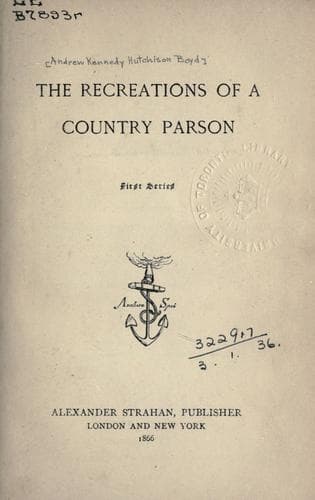
The Recreations of a Country ParsonBoyd, Andrew Kennedy Hutchison
General
The Recreations of a Country Parson
Boyd, Andrew Kennedy Hutchison
Clergy -- Anecdotes; Country life -- England; Rural clergy -- England
stage more rapid than the last; while to many the shadows are already
fast lengthening, and the declining sun warns them that 'the night
is at hand, wherein no man can work,' there should be those amongst
us whose whole thoughts are absorbed in the business of the world,
and to whom the reflection never occurs, that soon they must go
out into eternity, without a friend, without a home!
The discourse thus ends in orthodox Scotch fashion, with a practical
conclusion.
We think it not unlikely that the sermon has been toned down a good
deal before publication, in anticipation of severe criticism. Some
passages which were very effective when delivered, hate probably
been modified so as to bring them more thoroughly within the limits
of severe good taste. We think Mr. Caird has deserved the honours
done him by royalty; and we willingly accord him his meed, as a man
of no small force of intellect, of great power of illustration by
happy analogies, of sincere piety, and of much earnestness to do
good. He is still young--we believe considerably under forty--and
much may be expected of him.
But we have rambled on into an unduly long gossip about Scotch
preaching, and must abruptly conclude. We confess that it would
please us to see, especially in the pulpits of our country churches, a
little infusion of its warmth, rejecting anything of its extravagance.
CHAPTER XIII
CONCERNING FUTURE YEARS.
Does it ever come across you, my friend, with something of a start,
that things cannot always go on in your lot as they are going now?
Does not a sudden thought sometimes flash upon you, a hasty, vivid
glimpse, of what you will be long hereafter, if you are spared in
this world? Our common way is too much to think that things will
always go on as they are going. Not that we clearly think so: not
that we ever put that opinion in a definite shape, and avow to
ourselves that we hold it: but we live very much under that vague,
general impression. We can hardly help it. When a man of middle
age inherits a pretty country seat, and makes up his mind that he
cannot yet afford to give up business and go to live at it, but
concludes that in six or eight years he will be able with justice
to his children to do so, do you think he brings plainly before
him the changes which must be wrought on himself and those around
him by these years? I do not speak of the greatest change of all,
which may come to any of us so very soon: I do not think of what
may be done by unlooked-for accident: I think merely of what must
be done by the passing on of time. I think of possible changes
in taste and feeling, of possible loss of liking for that mode of
life. I think of lungs that will play less freely, and of limbs
that will suggest shortened walks, and dissuade from climbing hills.
I think how the children will have outgrown daisy-chains, or even
got beyond the season of climbing trees. The middle-aged man enjoys
the prospect of the time when he shall go to his country house;
Public-domain text, read in full here on John Shaqi.
Reviews
Reviews
No reviews yet
Be the first to share your thoughts on this work.
Elsewhere in the archive
Join the Discussion
Join the discussion
Sign in to leave a comment or review.
Sign InorCreate an account