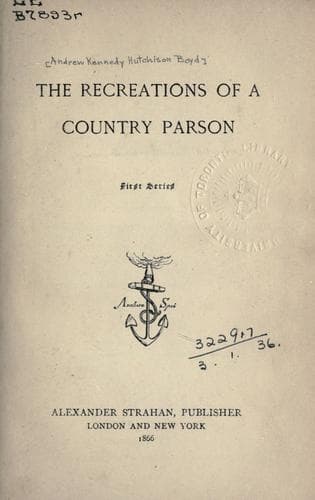
The Recreations of a Country ParsonBoyd, Andrew Kennedy Hutchison
General
The Recreations of a Country Parson
Boyd, Andrew Kennedy Hutchison
Clergy -- Anecdotes; Country life -- England; Rural clergy -- England
they are among the things which come up in the strange, confused
remembrance of the dying man in the last days of life. There is an
old fir-tree, a twisted, strange-looking fir-tree, which will be
among my last recollections, I know, as it was among my first. It
was always before my eyes when I was three, four, five years old:
I see the pyramidal top, rising over a mass of shrubbery; I see
it always against a sunset-sky; always in the subdued twilight in
which we seem to see things in distant years. These old friends
will die, you think; who will take their place? You will be an old
gentleman, a frail old gentleman, wondered at by younger men, and
telling them long stories about the days when Lincoln was President,
like those which weary you now about the Declaration of Independence.
It will not be the same world then. Your children will not be always
children. Enjoy their fresh, youth while it lasts, for it will not
last long. Do not skim over the present too fast, through a constant
habit of onward-looking. Many men of an anxious turn are so eagerly
concerned in providing for the future, that they hardly remark the
blessings of the present. Yet it is only because the future will
some day be present, that it deserves any thought at all. And many
men, instead of heartily enjoying present blessings while they are
present, train themselves to a habit of regarding these things as
merely the foundation on which they are to build some vague fabric
of they know not what. I have known a clergyman, who was very fond
of music, and in whose church the music was very fine, who seemed
incapable of enjoying its solemn beauty as a tiling to be enjoyed
while passing, but who persisted in regarding each beautiful strain
merely as a promising indication of what his choir would come at
some future time to be. It is a very bad habit, and one which grows
unless repressed. You, my reader, when you see your children racing
on the green, train yourself to regard all that as a happy end in
itself. Do not grow to think merely that those sturdy young limbs
promise to be stout and serviceable when they are those of a
grown-up man; and rejoice in the smooth little forehead with its
curly hair, without any forethought of how it is to look some day
when over-shadowed (as it is sure to be) by the great wig of the
Lord Chancellor. Good advice: let us all try to take it. Let all
happy things be enjoyed as ends, as well as regarded as means. Yet
it is in the make of our nature to be ever onward-looking; and we
cannot help it. When you get the first number for the year of the.
Magazine which you take in, you instinctively think of it as the
first portion of a new volume; and you are conscious of a certain
though slight restlessness in the thought of a thing incomplete,
and of a wish that you had the volume completed. And sometimes,
thus locking onward into the future, you worry yourself with litile
thoughts and cares. There is that old dog: you Lave had him for
Public-domain text, read in full here on John Shaqi.
Reviews
Reviews
No reviews yet
Be the first to share your thoughts on this work.
Elsewhere in the archive
Join the Discussion
Join the discussion
Sign in to leave a comment or review.
Sign InorCreate an account