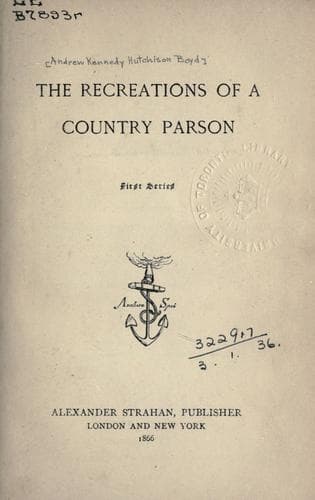
The Recreations of a Country ParsonBoyd, Andrew Kennedy Hutchison
General
The Recreations of a Country Parson
Boyd, Andrew Kennedy Hutchison
Clergy -- Anecdotes; Country life -- England; Rural clergy -- England
It is very difficult, in this world, to strongly enforce a truth,
without seeming to push it into an extreme. You are very apt, in
avoiding one error, to run into the opposite error; forgetting that
truth and right lie generally between two extremes. And in agreeing
with Sydney Smith, as to the wisdom and the duty of 'taking short
views,' let us take care of appearing to approve the doings of those
foolish and unprincipled people who will keep no out-look into the
future time at all. A bee, you know, cannot see more than a single
inch before it; and there are many men, and perhaps more women,
who appear, as regards their domestic concerns, to be very much
of bees. Not bees in the respect of being busy; but bees in the
respect of being blind. You see this in all ranks of life. You see
it in the artisan, earning good wages, yet with every prospect of
being weeks out of work next summer or winter, who yet will not be
persuaded to lay by a little in preparation for a rainy day. You
see it in the country gentleman, who, having five thousand a year,
spends ten thousand a year; resolutely shutting his eyes to the
certain and not very remote consequences. You see it in the man
who walks into a shop and buys a lot of things which he has not
the money to pay for, in the vague hope that something will turn
up. It is a comparatively thoughtful and anxious class of men who
systematically overcloud the present by anticipations of the future.
The more usual thing is to sacrifice the future to the present; to
grasp at what in the way of present gratification or gain can be
got, with very little thought of the consequences. You see silly
women, the wives of men whose families are mainly dependent on
their lives, constantly urging on their husbands to extravagances
which eat up the little provision which might have been made for
themselves and their children when he is gone who earned their
bread. There is no sadder sight, I think, than that which is not
a very uncommon sight, the care-worn, anxious husband, labouring
beyond his strength, often sorrowfully calculating how he may make
the ends to meet, denying himself in every way; and the extravagant
idiot of a wife, bedizened with jewellery and arrayed in velvet and
lace, who tosses away his hard earnings in reckless extravagance;
in entertainments which he cannot afford, given to people who do not
care a rush for him; in preposterous dress; in absurd furniture; in
needless men-servants; in green-grocers above measure; in resolute
aping of the way of living of people with twice or three times the
means. It is sad to see all the forethought, prudence, and moderation
of the wedded pair confined to one of them. You would say that it
will not be any solid consolation to the widow, when the husband
is fairly worried into his grave at last,--when his daughters have
to go out as governesses, and she has to let lodgings,--to reflect
that while he lived they never failed to have champagne at their
Public-domain text, read in full here on John Shaqi.
Reviews
Reviews
No reviews yet
Be the first to share your thoughts on this work.
Elsewhere in the archive
Join the Discussion
Join the discussion
Sign in to leave a comment or review.
Sign InorCreate an account