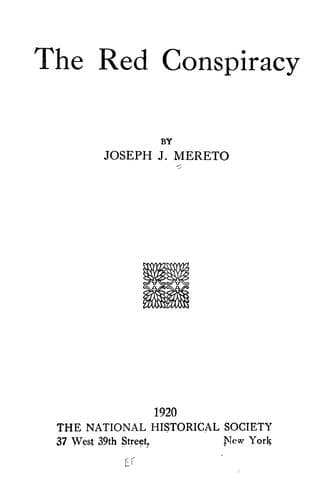
Communism; Industrial Workers of the World; Socialism
Furthermore, in the Russian land of Socialistic experiment the people,
left to themselves by the other nations, cannot find peace among
themselves. Why should there be peace as long as any manhood is left in
Russia to lift up its hand out of its despair against its Bolshevist
oppressors? Is civil war worth while--for such a barren result?
Finally, if the proletarian tyrants wear all Russia down until a spirit
of resistance is left in no breast, still will there be no peace; for,
as will be found quoted elsewhere in this book, Lenine declares that
Socialism cannot endure in a world half Socialistic and half
Capitalistic, so that his wretched Russian slaves seem likely to be
dragged into a war against the rest of the world to help out the crazy
experiment of domination by the proletariat. Is it worth while?
CHAPTER VIII
THE I. W. W.
The I. W. W., or the so-called "Industrial Workers of the World," whose
policy may be summed up in the words, "I Want to Wreck," and who in
derision are termed the "I Won't Works," the "Imported Weary Willies"
and the "Wobblies," enjoy the unenviable reputation of being classed
among the most insurrectionary, impious and infamous workers of the
world to-day. This industrial union, also known as the One Big Union, is
the bitter rival of the American Federation of Labor. Joseph J. Ettor,
in his I. W. W. pamphlet, "Industrial Unionism," page 5, speaking of the
fear that people have of the I. W. W. says:
"Yes, gentle reader, our ideas, our principles and object are
certainly dangerous and menacing, applied by a united working class
would shake society and certainly those who are now on top
sumptuously feeding upon the good things they have not produced
would feel the shock."
The I. W. W. was organized at a secret conference in Chicago, January 2,
1905, attended by 26 of the most radical Socialists in the country,
including Eugene V. Debs, William D. Haywood, William E. Trautman,
Thomas J. Haggerty, Daniel MacDonald, Charles H. Moyer, Charles O.
Sherman, Frank Bohn and A. M. Simons. Daniel De Leon was prominent at
the first convention, June 27, 1905, and for three years afterward, the
organization being founded on his theory that the Socialistic revolution
would not come by voting but by a violent seizure of the industries of
the country by Socialistic workmen industrially organized.
"The One Big Union Monthly," March 1, 1919, page 4, referring to the
hungry and desperate masses tells us:
Public-domain text, read in full here on John Shaqi.
Reviews
Reviews
No reviews yet
Be the first to share your thoughts on this work.
Elsewhere in the archive
Join the Discussion
Join the discussion
Sign in to leave a comment or review.
Sign InorCreate an account