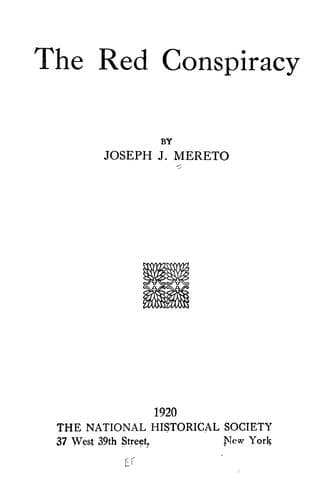
Communism; Industrial Workers of the World; Socialism
"Priest or Minister to show the One Big Union family why our
Solidarity Dogma is not superior to the ethical teachings of Jesus,
Buddha or Mohammed, also to demonstrate the inside of the religious
business, and where it is interwoven with Wall street."
"The Call," New York, May 3, 1919, in an editorial on "The Bomb Plot,"
which had just aroused the whole nation, said:
"The bomb and torch have not the slightest relation to any branch
of the organized labor movement in this country, and the editors
know it. Those who print such unfounded and slanderous insinuations
place themselves in the same class as the would-be-assassin."
This editorial was published the day after the following special
dispatch was sent to "The New York Times:"
"Sioux City, Iowa, May 2.--'We will blow the whole town to hell if
you put Mayor Short out of office.' This was the threat on a
postcard addressed to E. J. Stanson, who is trying to secure the
recall of Mayor Short. The card was received today. It was signed
'I. W. W. Alliance for Short.' The police are rounding up all
suspicious characters, and those known to have a leaning toward the
Bolshevists of the I. W. W. Citizens are seeking to oust Short
because he welcomed delegates to a recent 'wobblies' convention
here."
In the latter part of the spring of 1919 the author of "The Red
Conspiracy" obtained at the I. W. W. headquarters in Chicago a leaflet
entitled, "To Colored Workingmen and Women!" Part of it is hereby
quoted:
"To the black race, who, but recently, with the assistance of the
white men of the northern states, broke their chains of bondage and
ended chattel slavery, a prospect of further freedom, of Real
Freedom, should be most appealing.
"For it is a fact that the negro worker is no better off under the
freedom he has gained than the slavery from which he has escaped.
As chattel slaves we were the property of our masters, and as a
piece of valuable property our masters were considerate of us and
careful of our health and welfare. Today, as wage-workers, the boss
may work us to death at the hardest and most hazardous labor, at
the longest hours, at the lowest pay; we may quietly starve when
out of work and the boss loses nothing by it and has no interest in
us. To him the worker is but a machine for producing profits, and
when you, as a slave who sells himself to the master on the
installment plan, become old, or broken in health or strength or
should you be killed while at work, the master merely gets another
wage slave on the same terms.
Public-domain text, read in full here on John Shaqi.
Reviews
Reviews
No reviews yet
Be the first to share your thoughts on this work.
Elsewhere in the archive
Join the Discussion
Join the discussion
Sign in to leave a comment or review.
Sign InorCreate an account