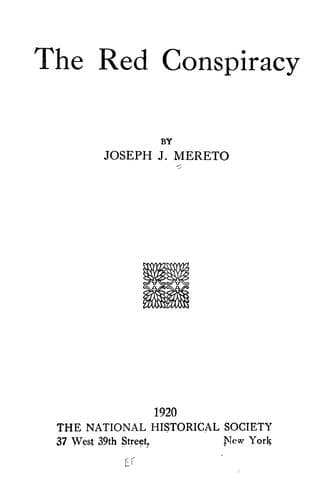
Communism; Industrial Workers of the World; Socialism
Shortly after these reports reached America, the peasants of Bavaria
rose up against the revolutionary government in Munich and declared an
effective ban on the shipment of food to that city. No attacks were made
upon Munich by the troops of the moderate Hoffman government of Bavaria
which had been ousted by the Communists, for it was feared that the
whole country might thus be plunged into civil war. The only strategic
movement of these troops was to cut off the supplies of food.
Discord soon sprang up among the Soviet leaders themselves, who engaged
in open street fights against each other. Before the end of April, 1919,
the Central Council had been dissolved and the Communist mob had turned
to plundering. Food ration cards were taken away from the bourgeoisie,
and barricades were erected around the city to defend it from Noske's
army, sent to attack it by the Ebert-Scheidemann moderate Socialist
Government of Berlin. In the early part of May, 1919, the Communist
rabble of the Bavarian capital was finally overcome by the artillery
fire of Noske's troops, and Hoffman was once more put in control.
The American Socialists look upon the ousted Communists of Bavaria as
the upholders of the Marxian doctrine, and consider them, along with
the Russian Bolsheviki and the Hungarian Communists, as Socialist
brethren worthy of their respect and imitation.
In Hungary the "100 per cent" Socialists, the Communists, under the
leadership of Bela Kun, came into power in the early part of the year
1919. Press despatches, at the end of March, stated that all villas,
industries and building had been declared the property of the state;
that each factory was controlled by a Council of Laborers; that
free-love was legalized as in Russia; that all clergymen and nuns were
removed from the hospitals, excepting those who acted in the capacity of
nurses, and the religious, tuition schools were abolished.
A press dispatch dated Buda-Pest, April 4, 1919, said that "in
Transylvania, following the practice in Moscow, the churches have been
converted into music halls, the best seats being reserved for the
proletariat. The government officials do not pay house rent and have
priority on foodstuffs and clothing."
The American Socialists boasted about the absence of bloodshed in
Hungary during the early part of Bela Kun's regime. Whether or not he
had been cautioned by Lenine not to wear out too many rifles in the
beginning, lest there be a dearth later on, we do not know. At any rate,
by the latter part of May, 1919, the Hungarian Communists also began to
manifest their true color. They were not satisfied with "painting
everything red" in Buda-Pest, but also wanted to see red blood flowing
in the gutters. In confirmation of this we have the following Associated
Press report, dated Vienna, May 20, but not appearing in the "New York
Times" till May 23:
Public-domain text, read in full here on John Shaqi.
Reviews
Reviews
No reviews yet
Be the first to share your thoughts on this work.
Elsewhere in the archive
Join the Discussion
Join the discussion
Sign in to leave a comment or review.
Sign InorCreate an account